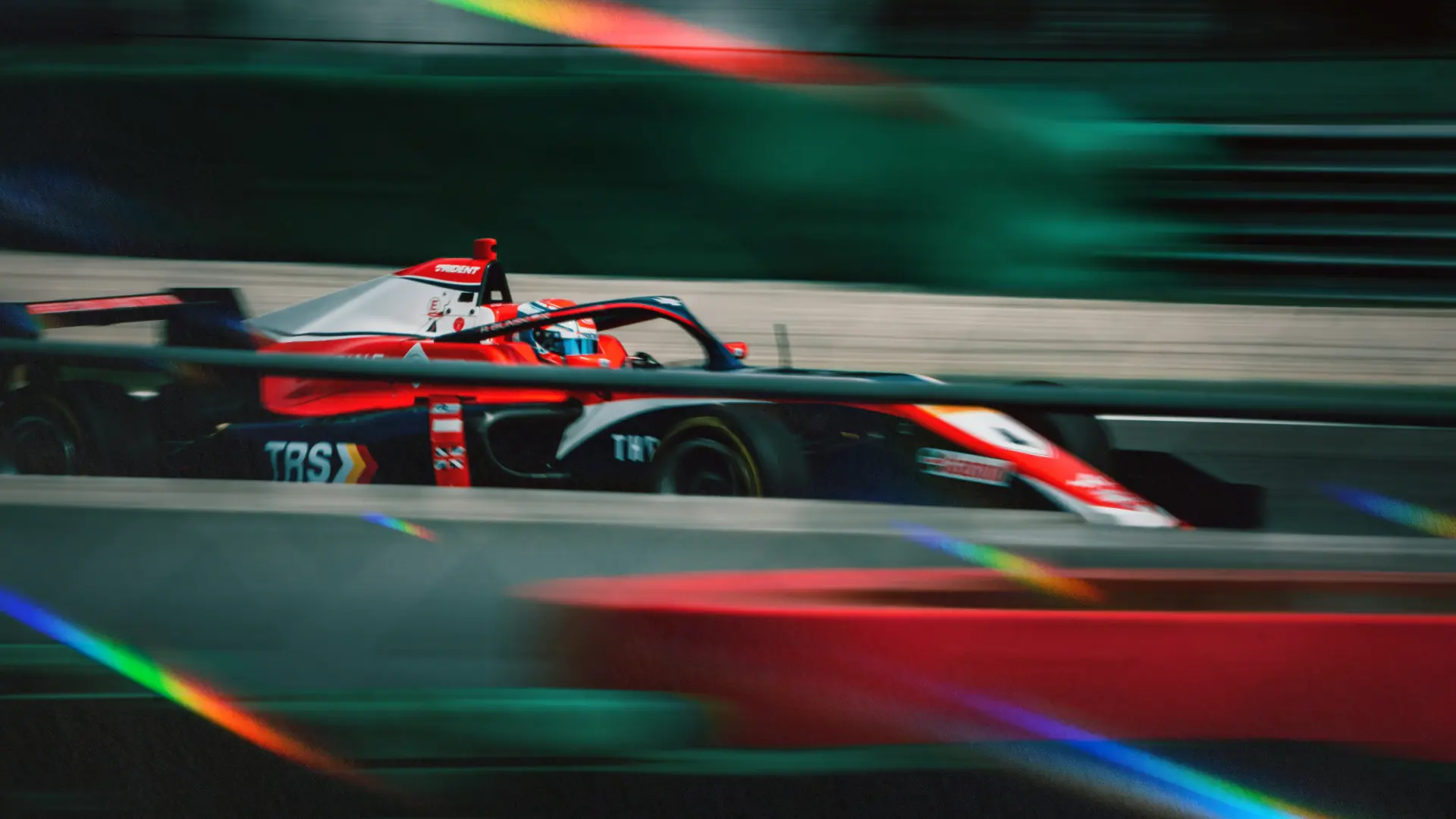

Updated August 2026 · Formula 1's 2026 grid brought its biggest commercial shake-up in years. A new eleventh team joined the field, luxury houses moved in trackside, and a wave of tech and finance brands signed on across the paddock.
All that movement makes the sponsor roster worth a proper look: who backs Formula 1, at what level, and in which industries.
Together, those answers show where sponsorship money is heading, both on the cars and across the sport itself. So this guide lays out every official F1 partner for 2026, the team deals sitting beneath them, and how brands measure what all that exposure actually returns.
F1's official sponsors in 2026, at a glance
Formula 1's own partners sit above the teams. These are brands that back the championship itself, appearing across every race weekend rather than on a single car. For 2026 the roster runs to more than thirty names, from decade-long backers to first-season arrivals such as Standard Chartered.
The full list, sorted by the tier F1 assigns each brand, is below.
F1's official partners, by tier
Formula 1 sorts its partners into four tiers. The tier tells you how prominent and how global a brand's presence is, so it is the quickest way to read the roster.
Global Partners
The top tier. Aramco, AWS, DHL, Heineken, Lenovo, LVMH, MSC Cruises, Pirelli, Qatar Airways and Salesforce sit here, with year-round visibility across the calendar. When people search for F1's "main" or "biggest" sponsors, these are the names they mean.
Official Partners
The next band down, including American Express, Crypto.com, Santander, PwC, Nestlé, Paramount+, Louis Vuitton, Moët Hennessy, TAG Heuer and 2026 arrival Standard Chartered.
Regional Partners
Brands that activate in specific markets rather than worldwide, such as McDonald's and T-Mobile.
Official Providers
Companies that supply a service to the sport, among them Puma, Tata Communications, Aggreko and Flexjet.
F1 sponsors by category
The tier tells you how prominent a brand is, but the category tells you why it is there. Sort the same roster by sector and a different picture appears, one that maps the industries betting on Formula 1 and shows how far that mix has widened beyond the fuel, tyre and tobacco money of the sport's early decades.
Six sectors now carry most of the grid, from energy and cloud computing to banking, food and, increasingly, luxury. The infographic below groups every official F1 partner by the industry it comes from.
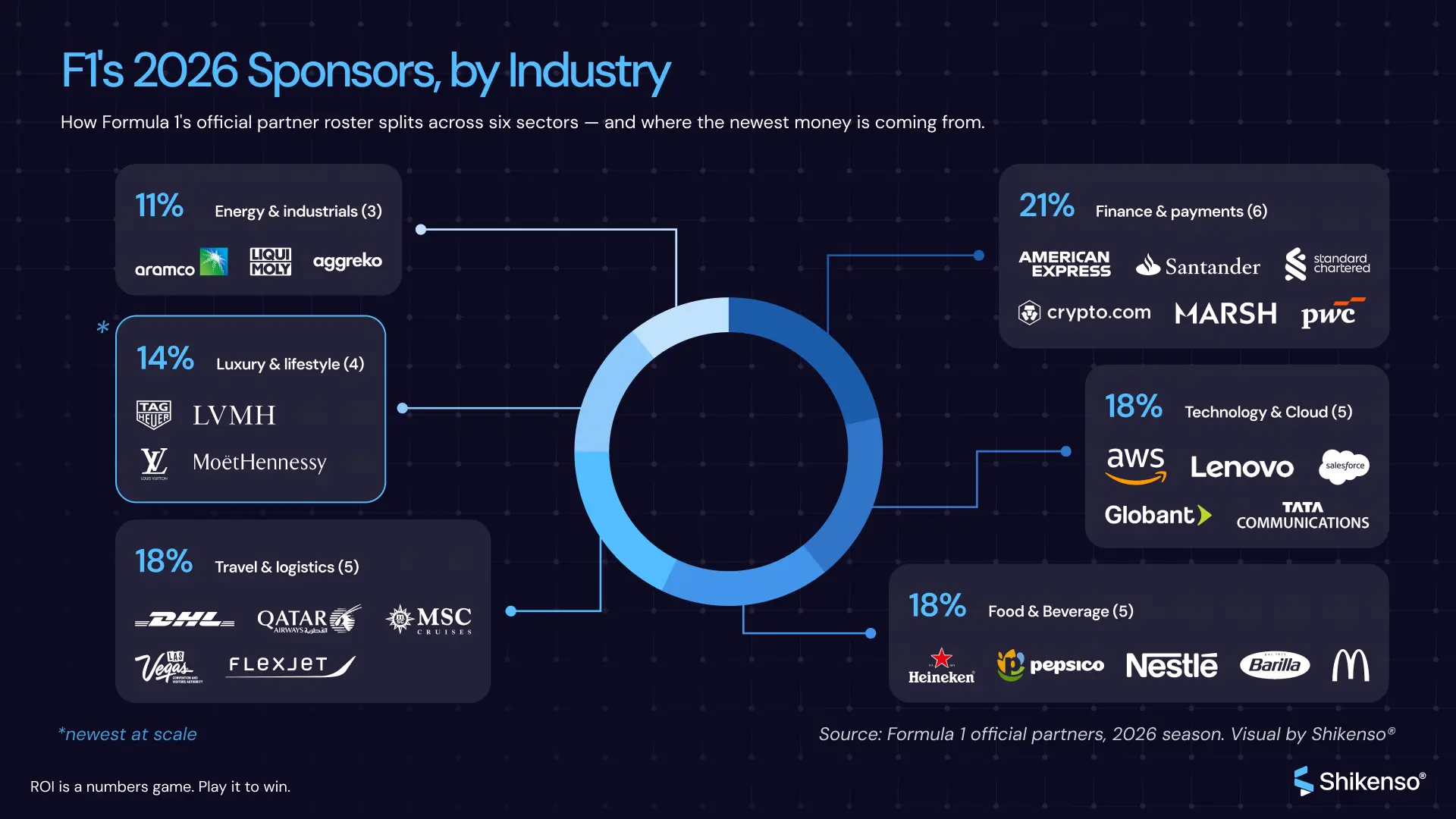
The mix says more than any single logo. Technology and finance now supply more of F1's partners than any other sectors, which shows how the sport sells itself as a global business and data platform, not only a race. Energy names like Aramco still hold some of the most valuable positions, yet they no longer define the grid the way fuel and tyre brands once did.
The sharpest change sits in luxury. When LVMH signed in 2025 it brought Louis Vuitton, Moët Hennessy and TAG Heuer into the sport in a single deal, anchoring a category that barely existed on the grid a decade ago. Food, beverage and travel brands round out the rest, each chasing the younger, more global audience F1 has built under Liberty Media.
F1 car and team sponsors: how the deals differ
F1's own partners are only half the picture. Each team runs its own sponsorship programme, which is why a single car can carry 25 to 35 logos while the championship carries around thirty.
Team deals work differently from F1-wide ones. A title sponsor buys naming rights to the team, such as Oracle with Red Bull or Atlassian with Williams. Below that sit principal and official partners, technical suppliers, and smaller trackside backers. The same brand can appear at both levels, as Aramco does with F1 and with Aston Martin.
The interactive table below breaks down the current backers for each of the eleven 2026 teams.
How F1 sponsorship evolved, 2004 to 2026
Today's roster is the product of two decades of change, in three broad phases.
The early era: logistics, tyres and energy
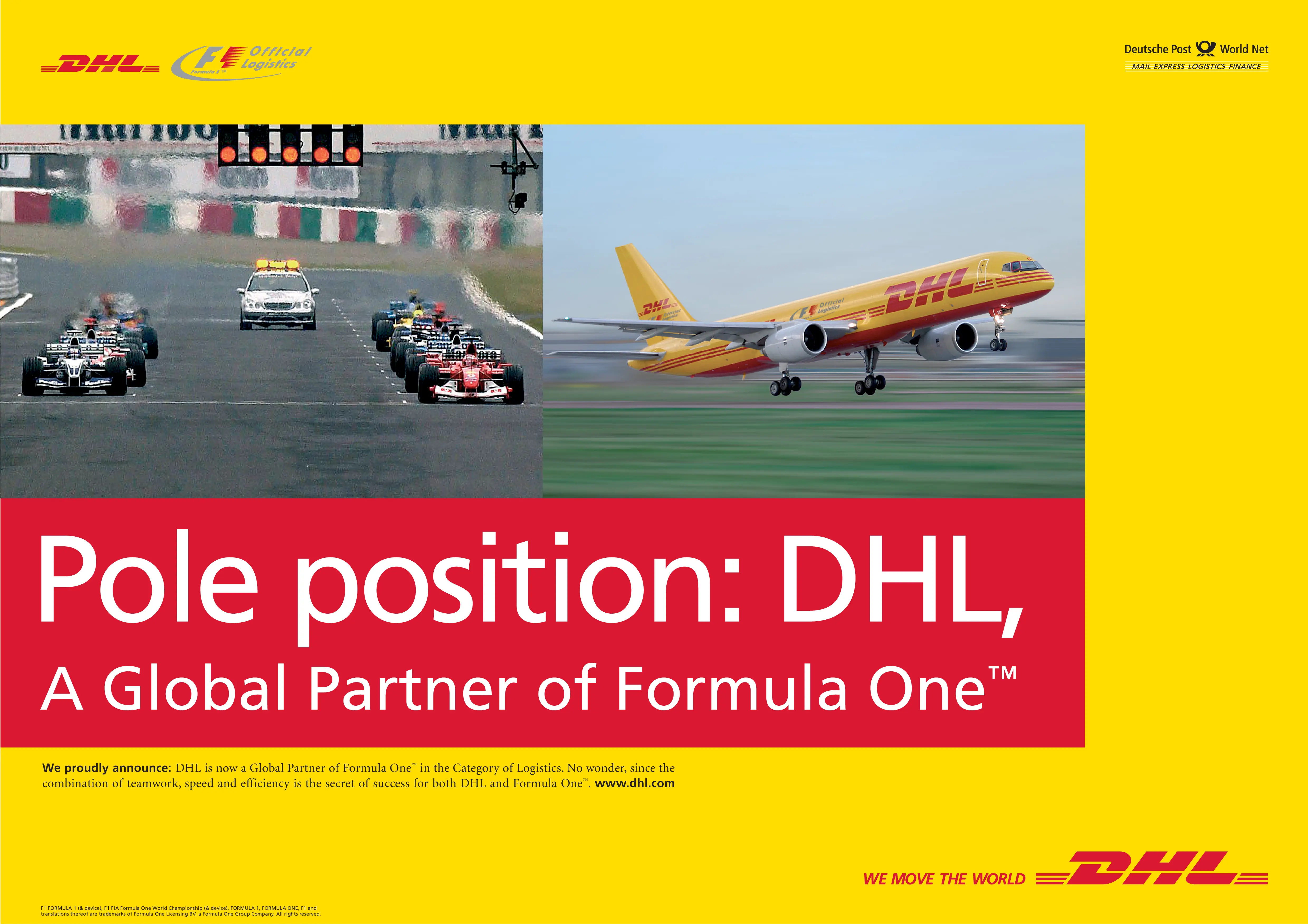
DHL became one of the sport's foundational partners in 2004, and for years logistics, tyres and energy brands defined the commercial line-up. These were businesses that fit motorsport's engineering image, and several of them are still on the grid today.
The tech wave, from 2018
AWS joined in 2018, and cloud and data brands changed how sponsors showed up. Instead of a logo on a car, they turned live race data into content for fans, which made technology one of the sport's most visible categories.
The luxury and finance era, 2025 onward
Where motorsport money once came from tobacco and carmakers, the 2026 roster is led by banks, payment networks, streaming services and fashion houses. That shift follows the audience F1 has built, younger and more global than at any point in its history.
For a closer look at one part of that shift, see how the beauty industry moved into F1.
How brands measure the value of F1 sponsorship
Sponsorship has become one of Formula 1's fastest-growing income lines, yet the harder question sits with the brands paying for it: what does all that exposure actually return?
A logo on a car is only worth something once you can measure it properly. Counting impressions tells you how many people might have seen your brand, but not what a placement was worth, and not whether those ten seconds on screen came during a lead battle or a quiet lap behind the safety car. That gap is where we come in.
Shikenso track every branded exposure across a race weekend and turn it into media value you can verify and act on. Here is how we prove what your F1 sponsorship really delivered.
See every placement, from livery to LED board
We find your brand wherever it appears, whether that is a sidepod logo, a trackside board, a suit patch or a broadcast overlay. Our AI reads the feed frame by frame, so no visible placement slips through.
Pick up spoken mentions too
Exposure goes beyond what fans see. We also catch audible and verbal mentions, from a commentary callout to a post-race interview, so the value your sponsorship earns off-screen still gets counted.
Follow it across every channel
Broadcast, streaming, social, print and audio all land in one view. That way you can see how your placement performed on the world feed and in the clips fans share long after the chequered flag.
Turn it into media value you can defend
Because every figure traces back to the exact moment it came from, you negotiate from your own verified numbers rather than a partner's estimate. Just like MOONTON Games, who proved €158M in media value at their M7 World Championship, you make the next call on data you control.
That clarity cuts both ways. A brand can check exactly what a sponsorship delivered before signing the next one, while a rights holder or team can show partners the value they earned and protect the renewal. Either way, the numbers belong to you.
See what that looks like for your own sponsorships.
F1 sponsors FAQ:
Who is F1's biggest sponsor?
By tier, F1's Global Partners are its most prominent backers, a group that includes Aramco, AWS, DHL, LVMH and Pirelli. LVMH's deal is among the largest by reported value.
How many sponsors does F1 have?
The championship itself has more than thirty official partners in 2026. Counting team-level sponsors across all eleven teams, the total runs into the hundreds.
Which luxury brands sponsor F1?
LVMH is the sport's luxury anchor, bringing Louis Vuitton, Moët Hennessy and TAG Heuer. Several teams also carry luxury watch and fashion partners of their own.
How do brands measure F1 sponsorship value?
By tracking branded exposure across broadcast and social feeds and converting it into media value, rather than counting impressions alone.

Related reads



Get new insights straight to your inbox
Don’t miss out on the insights that the press and media rave about!