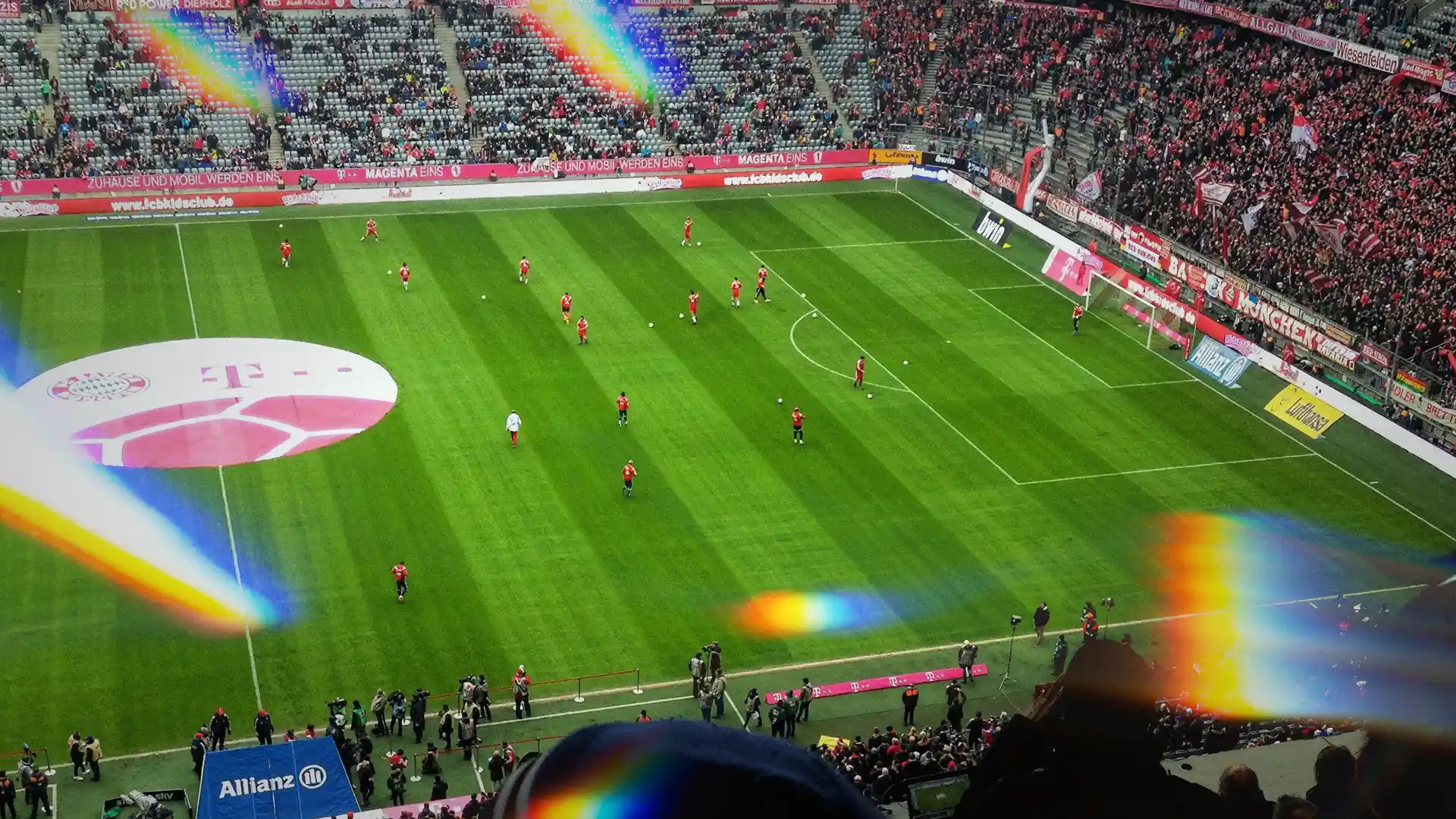

Perimeter advertising has come a long way since someone painted a logo on plywood and called it sponsorship. Today's LED systems and virtual overlays pump out millions in media value across the Premier League, Bundesliga, and UEFA competitions.
The problem? Most brands still can't prove what they're actually getting. Vague estimates and "trust us" reports don't cut it when you're spending six figures on pitch-side visibility.
This guide breaks down the technology actually driving modern perimeter advertising, shows you how to measure real exposure value (not guesswork), and explains what implementation costs. Whether you're a rights holder tired of sponsors questioning your numbers or a brand demanding proof beyond pretty PowerPoints, here's what matters.
What Is Perimeter Advertising?
Perimeter advertising is the branded signage (static, LED, or virtual) positioned around the edge of a sports pitch to reach both the live crowd and the broadcast audience during a match. These displays are also called football advertising boards, perimeter advertising boards, pitch-side boards, or stadium advertising boards; in the US they are usually called soccer field advertising. They appear in several formats depending on the venue and league.
Common formats:
- Static boards: Traditional printed banners still widely used in grassroots sports and lower-league fixtures
- LED displays: The professional standard, offering dynamic digital content with rotating sponsors and animated graphics
- Virtual overlays: AI-powered technology showing different sponsors to different regional broadcast audiences
- Parallel ads: Specialised hardware systems displaying different sponsors simultaneously to multiple cameras
You'll find modern perimeter systems across the Premier League, Bundesliga, La Liga, and UEFA competitions. The painted boards are history. The tech has moved on.
Why Perimeter Advertising Works
You Can't Skip It
Unlike traditional TV ads that get zapped the second halftime starts, perimeter advertising sits right there in the action. Fans watching the match see your brand without lifting a finger to avoid it.
The best part? Your logo appears during the moments people actually care about. Goals. Penalties. Last-minute saves. That's when viewers lean forward, not when they're reaching for the remote.
What you get:
- Captive audience: Nobody skips live football to avoid your board
- Emotional stickiness: Your brand shows up in the moments fans remember
- Bonus broadcast time: Every replay, close-up, and highlight package gives you more screen time
Real Numbers, Real Reach
Perimeter advertising doesn't just work in the stadium. Here's where your brand actually shows up:
One board placement. Four different ways to reach people.
How to Measure Perimeter Advertising ROI
You measure perimeter advertising ROI by tracking exactly how long, how large, and how clearly each sponsor logo appears across TV, streaming, and social, then converting that exposure into media value using geo-localised CPMs, not season-end estimates.
The Old Way: Trust Me, Bro
For years, sponsors got reports like this: "Your logo was visible for approximately 47 minutes across the season." Approximately. No proof, no breakdown, just a number someone pulled together weeks after the final whistle.
Try taking that into a renewal meeting.
The Actual Way: Frame-by-Frame Proof
Shikenso's platform tracks perimeter advertising the way it should be tracked—with precision. We analyse every broadcast frame across TV, streaming, and social media. No estimates. No "roughly speaking."
What we measure:
- Duration: Exact seconds each logo appears on screen
- Size: Percentage of screen space occupied
- Quality: Visibility level (full view, partial, obstructed)
- Context: Exposure during high-value moments (goals, penalties)
- Media value: Monetary equivalent across TV, social, streaming
Our system detects sponsor assets across different placements and distinguishes the same logo whether it's on LED boards, jerseys, or backdrops. The platform then converts exposure into actionable ROI data.
How This Works in Practice
Take the Belgian Pro League. We track every perimeter exposure across all 29 clubs—every match, every broadcast, every social media clip. When rights holders sit down for renewals, they don't bring estimates. They bring exact media value, broadcast minutes, and exposure quality for each brand.
Sponsors see real ROI. Rights holders prove real value and walk into renewals with verified media value instead of estimates, so deals close without the usual back-and-forth over whether the numbers are legit.
Track your perimeter advertising performance with frame-accurate data.
Technology Behind Modern Perimeter Advertising
LED Boards: More Than Just Billboards
LED perimeter systems took over because they do what static boards can't—change content without sending someone out with a ladder and new vinyl. Multiple brands rotate through the same board space every 30 seconds. Animated content grabs attention 23% better than static images. And when your team scores? Trigger a celebration graphic with a promo code.
Live. Dynamic. Measurable.
Board configurations:
Virtual Advertising in Football: Same Board, Different Sponsors
Here's where it gets interesting. Virtual advertising in football is broadcast technology that digitally replaces the physical LED perimeter boards a stadium crowd sees with different sponsors for each TV region. The stadium sees one set of brands; a viewer in Germany, Asia, or the Middle East sees another, all from the same match feed.
How it works:
- LED boards display content in the stadium
- AI detects exactly where those boards are in the camera feed
- Different sponsors get inserted for different broadcast regions
- Viewers in Germany see German brands. Viewers in Asia see Asian brands. Same match. Same board. Different money.
One Bundesliga match can generate 4-8 separate advertising feeds without touching a single piece of hardware. That's how you multiply inventory without multiplying costs.
Example: Bayern Munich plays Dortmund. Fans in the stadium see one set of sponsors on the LED boards. German TV viewers see German brands. Asian broadcasts show Asian sponsors. Middle Eastern feeds display MENA partners. Same match, same boards, four different revenue streams.
Parallel Ads: Hardware That Does the Heavy Lifting
Unlike virtual overlays (which are software-based), parallel ads use specialised LED panels that emit different content at different frequencies. Broadcast cameras pick up these frequencies and show different sponsors accordingly.
Where it's approved: Bundesliga (2024), select Premier League trials
The catch: You need to upgrade hardware across your entire perimeter. It's not cheap, but it works without software intervention.
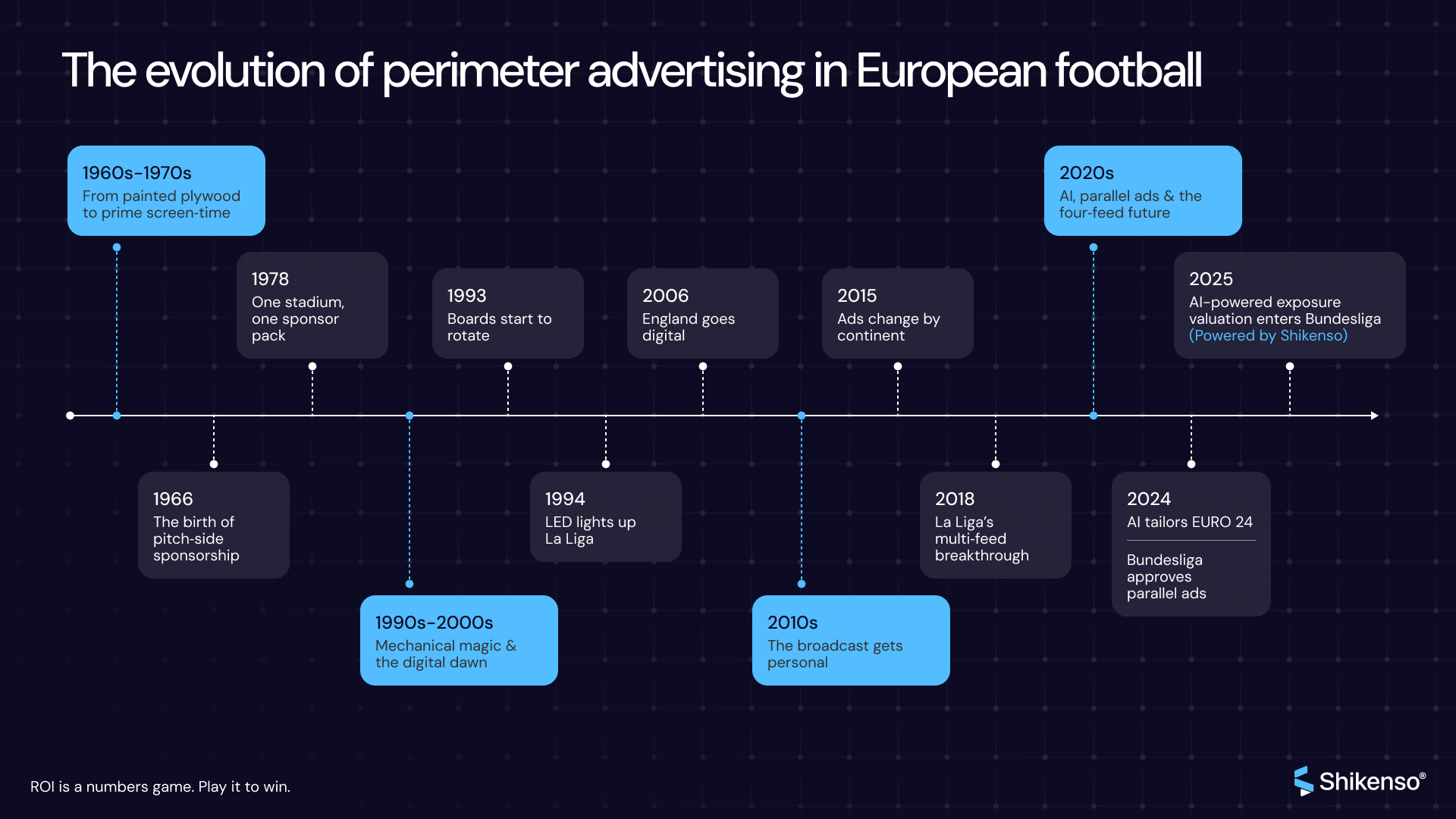
Brief History: From Vinyl to AI
Perimeter advertising didn't start sophisticated:
Cost Factors: What Influences Perimeter Advertising Pricing
Perimeter advertising costs are set by private negotiation, but the main drivers are stadium size and reputation, board location, team popularity, event type, ad format (static vs. LED vs. virtual), and campaign duration.
Hardware Investment (For Venue Owners)
Note: Hardware pricing varies significantly by region, league requirements, and supplier. Contact LED manufacturers directly for accurate quotes.
Advertising Space Rental (For Brands)
What drives the price:
- Stadium size & reputation: Premier League clubs charge more than League Two venues. Shocking, we know.
- Board location: TV-visible areas (penalty boxes, centre circle) cost premium. That's where the cameras point.
- Team popularity: Champions League clubs versus relegation battlers. The audience size difference shows up in the invoice.
- Event type: Cup finals and internationals cost more than Tuesday night league fixtures.
- Ad format: LED boards are pricier than static. Virtual overlays add regional targeting premiums.
- Campaign duration: Season-long partnerships versus one-match activations.
How Packages Usually Work
Most brands see pricing structured around per-match fees for one-off activations, season contracts covering all home matches, rotation share where multiple sponsors divide board time, or exclusive full-board where one sponsor dominates the entire perimeter at the highest cost.
Want exact numbers? Contact clubs or agencies directly. Competitive bidding and bespoke negotiations mean publicly listed prices basically don't exist.
Proving ROI, The Shikenso Way
For clubs and teams delivering sponsor reports, this is the difference between chasing spreadsheets and handing every partner provable, asset-by-asset media value on demand.
What Manual Tracking Gets You vs. What We Deliver
What We Actually Track
Our platform catches everything:
- Visual exposure: Logo placements on LED boards, static banners, backdrops
- Audible mentions: Commentator shout-outs, stadium announcements
- Legible text: Sponsor names in graphics, overlays, on-screen captions
Every single data point links back to where it came from—the broadcast footage, the social post, the streaming clip. You get proof of anything that is measured.
No More Waiting for Quarterly Reports
Log into your dashboard. See your perimeter performance. Right now. Not three weeks from now after someone manually counted logos in spreadsheets. Track exposure during the match and adjust your next campaign before the season ends.
What our clients achieve with real data:
- 269% ROI increase after ditching estimates for frame-accurate tracking
- 45% more media value proved for kit sponsoring on international broadcasts
- €115M tracked in media value for brand partners during flagship tournaments
Numbers that hold up in renewal meetings. That's the difference.
The Future of Perimeter Advertising
Interactive Boards Are Coming
Passive visibility is getting replaced by active engagement.
QR codes that pop up during key moments. Scan the board after a goal, unlock exclusive content or a discount code. Second-screen experiences that let fans dive into live stats while your brand facilitates it. AI analytics tracking which moments drive the most engagement so you know what's actually working.
AR Will Personalise Everything
Regional targeting is just the start. Augmented reality will eventually let advertisers show different content based on individual viewer preferences, not just geography. That's where this heads next.
Sustainability Becomes Non-Negotiable
LED systems are getting smarter about energy use. IP-controlled power management turns displays off when they're not needed. Higher pixel density means sharper visuals with fewer panels. Longer lifespan means less frequent replacement. The tech improves, the environmental cost drops.
Frequently Asked Questions:
How do football advertising boards work?
Modern football advertising boards are LED panels that run around the pitch perimeter and rotate multiple sponsors' content, typically changing every 30 seconds. They display animated graphics visible to the stadium crowd and, more valuably, to the broadcast camera. Advanced systems can also show different sponsors to different TV regions from the same physical board.
Can football players see the advertising boards?
Yes. The LED boards face the pitch and are clearly visible to players, though players are focused on the game and don't actively watch them. The primary audience is the broadcast camera and the TV, streaming, and social audiences it reaches.
Are the ads on the football field real?
The boards physically exist in the stadium, but what a TV viewer sees is often not the same as what's in the ground. Virtual advertising technology can digitally replace the on-screen boards with region-specific sponsors, so the "ad" you see at home may differ from the one the live crowd sees.
Why do football stadium ads look different in each country?
Because of virtual advertising and regional feed replacement. Broadcasters in different countries receive different versions of the perimeter boards, so a German viewer sees German brands while an Asian broadcast shows Asian sponsors. Same match, same boards, different ads.
What are parallel ads in football?
Parallel ads use specialised LED panels that emit different content at different frequencies. Broadcast cameras pick up a specific frequency and show one sponsor, while the stadium crowd sees another, a hardware-based alternative to software virtual overlays. Parallel ads were approved in the Bundesliga in 2024 and trialled in the Premier League.
How much does perimeter advertising cost?
Pricing is negotiated privately with clubs, leagues, or rights holders and isn't publicly listed. For venue owners, LED panels run roughly €370–€930 per m² plus 15–30% for installation. For brands, cost depends on stadium profile, board location, team popularity, event type, ad format, and campaign duration.
How is perimeter advertising ROI measured?
By analysing every broadcast frame to record the exact duration, on-screen size, and visibility quality of each logo across TV, streaming, and social, then converting that exposure into media value with geo-localised CPMs, replacing season-end estimates with frame-accurate proof.
ROI Is a Numbers Game. Play It to Win.
Perimeter advertising went from painted plywood to AI-powered precision. The brands winning today don't accept estimates. They demand proof.
Shikenso tracks every second your brand appears—across TV, streaming, social media, and print. Our AI spots your logo whether it's on a jersey, an LED board, or a digital overlay. Then we convert that visibility into actual media value you can defend in any renewal meeting.
Rights holders walk in with frame-accurate data. Brands get indisputable proof of exposure. Renewals close because the numbers speak louder than promises.

Related reads


Get new insights straight to your inbox
Don’t miss out on the insights that the press and media rave about!