

A logo shows up on screen.
Then it's gone.
What's left is usually a rough estimate, drawn from a partial manual review, a broadcast partner's summary, or someone's recollection of how prominent the placement looked. For a brand that paid real money for that moment, it's a thin basis for any commercial decision.
Logo detection changes what's possible. Estimates become data. Every appearance is logged, timestamped, and measured: how long, how visible, in front of how many people, across which channels. The guess is replaced with a verifiable record.
What Is Logo Detection?
Logo detection is the use of AI and computer vision to automatically identify and track brand logos in video, images, and live broadcast content.
In plain terms: it finds your brand logos wherever they appear, measures exactly how they appeared, and converts that into usable data.
A logo detector works across broadcast footage, streaming platforms, social media clips, OTT content, and more, automatically, at scale, without a human reviewing every frame.
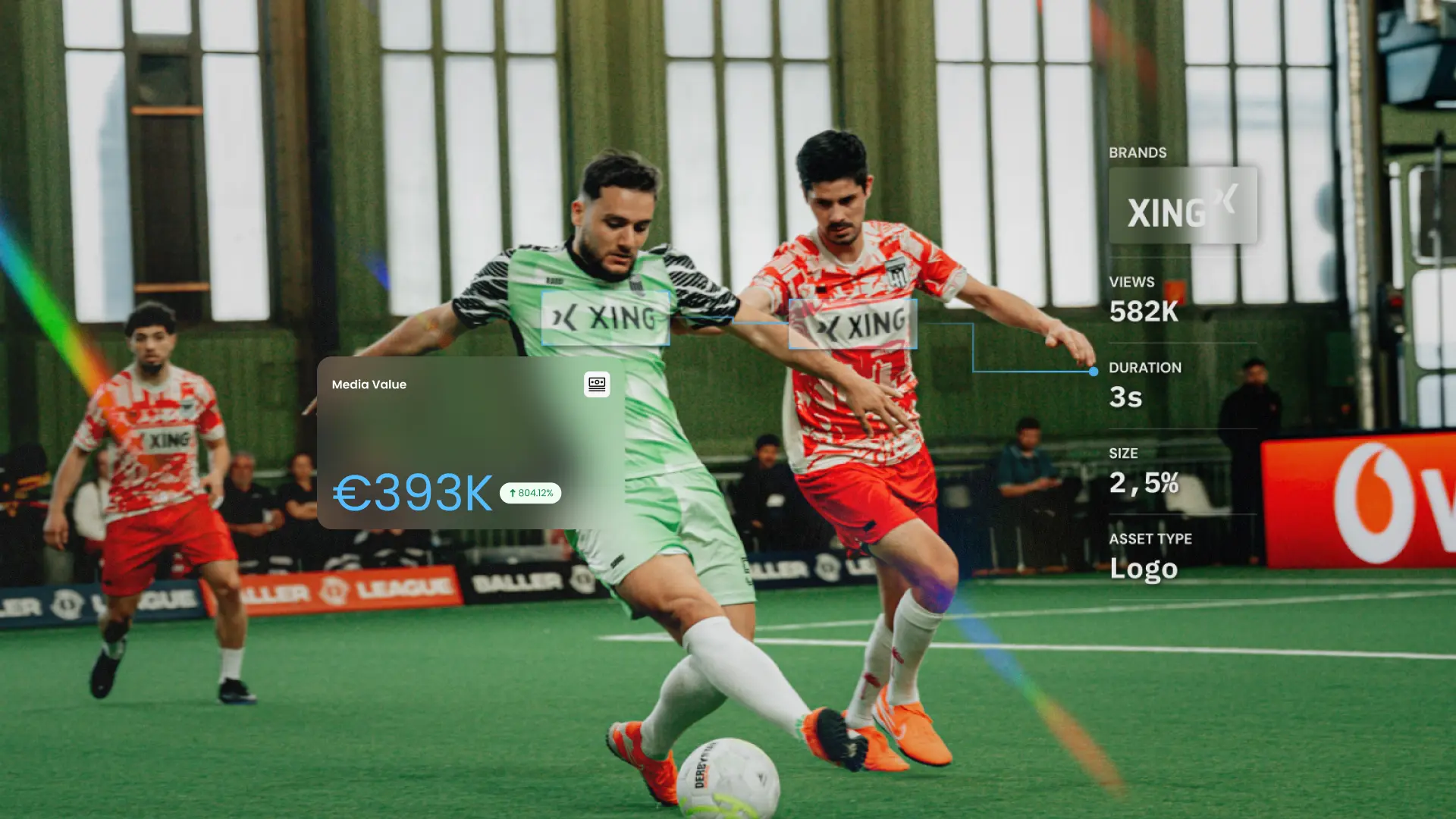
See it in action:
Seeing it run on a clip is one thing; seeing it on your own broadcasts, streams and social is where it clicks. Book a short walkthrough and we will show you what logo detection surfaces on your footage.
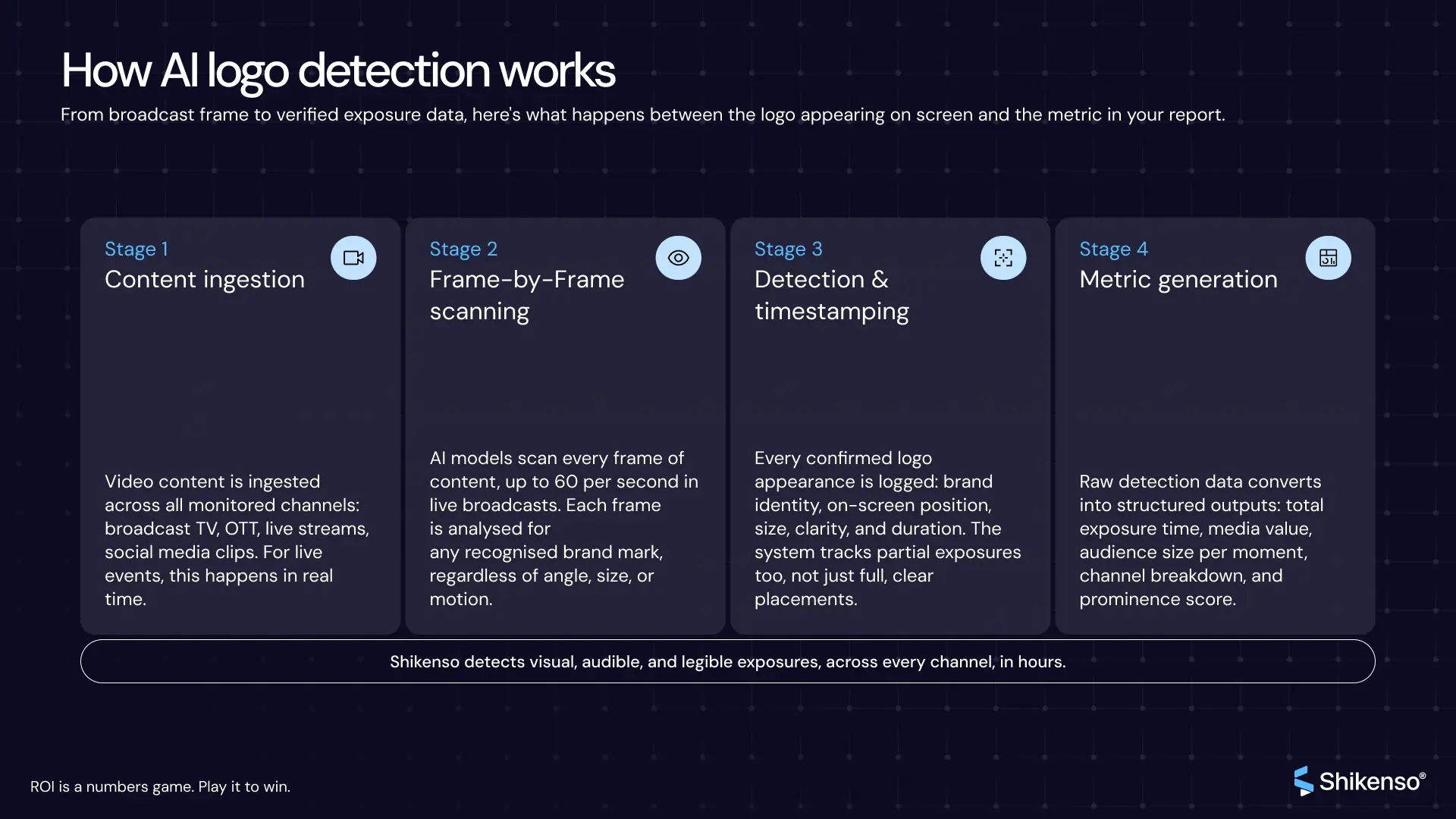
How AI Logo Detection Works
The technology runs in four sequential stages:
What Logo Detection Actually Measures
A capable detection system measures the quality of each exposure, not just the count:
Each of these variables affects the commercial value of an exposure. A logo occupying a third of the screen during a peak-viewership moment carries significantly more value than a small corner placement during a low-traffic segment.
Detection data is how you demonstrate that difference with evidence, not assertion.
Traditional Sports vs. Esports: Two Different Challenges
Logo placement in traditional sports follows relatively predictable patterns. Pitch-side boards, jersey branding, and broadcast graphics appear in consistent physical locations. Camera positions are established and repeated. The measurement challenge is primarily about coverage and consistency.
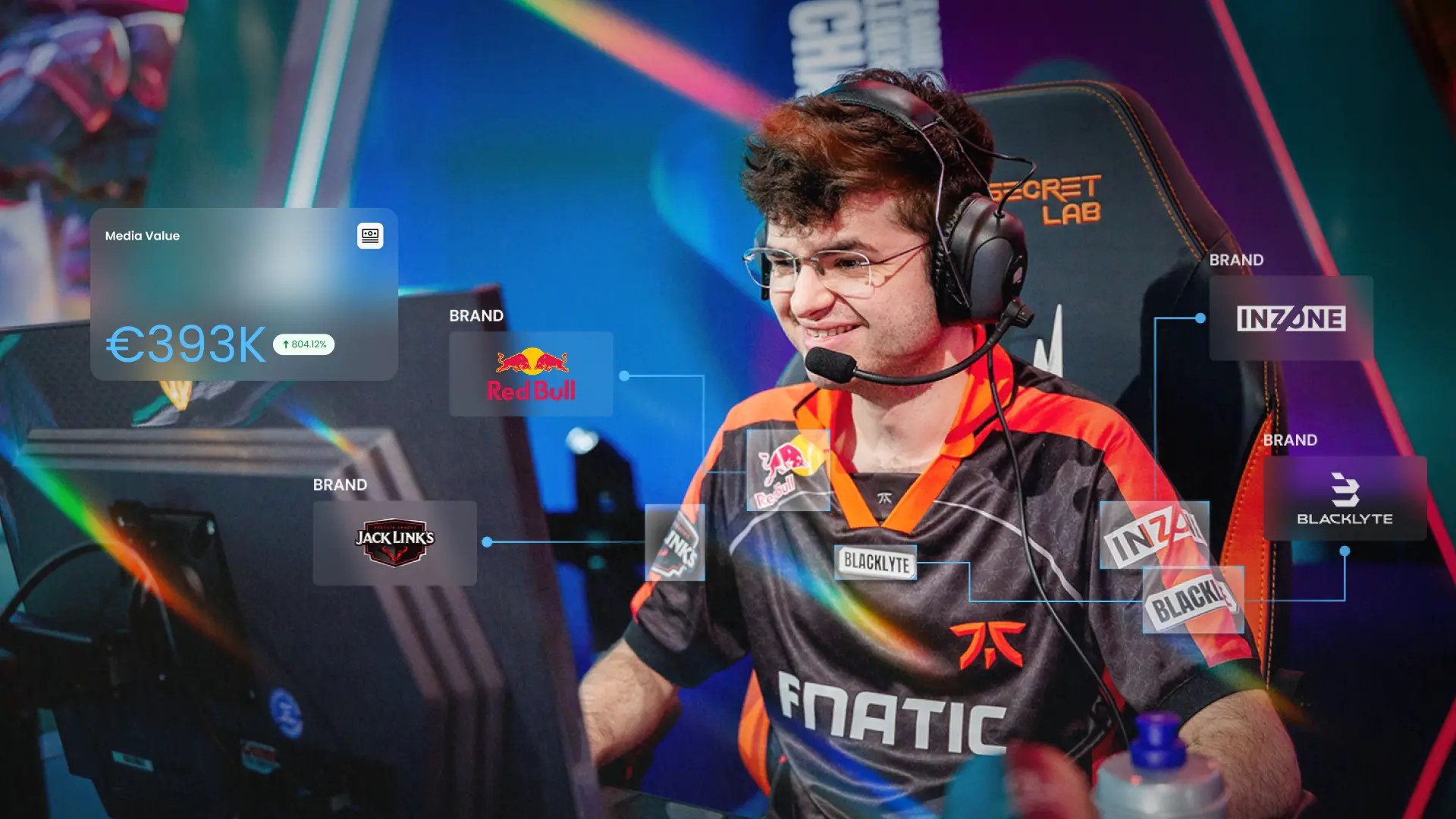
Esports operates differently. Brand placements exist across:
Esports widens that gap further, spreading placements across countless simultaneous streams that no manual process can realistically follow.
This is why esports-specific detection logic matters. A detection model trained to identify a pitch-side board in a football broadcast needs different source data and training to reliably identify a logo shifting position on a streaming overlay mid-match.
Why This Matters for Sponsorship Value
The global sports sponsorship market was valued at approximately €60 billion in 2024, and 76% of marketers who invested in sports sponsorship that year said they struggle to calculate ROI. That gap exists largely because the exposure data needed to calculate value either doesn't exist or can't be verified.
Logo detection closes it. Once you know how long a brand appeared, in what context, and to how many people, you can calculate media value: the monetary equivalent of that exposure, benchmarked against comparable advertising costs across the same channels and audiences.
A sponsor who receives a report showing €2.4 million in verified media value, broken down by channel and moment, has something tangible to defend internally. Without detection, that same sponsor receives an impressions estimate, a few screenshots, and a number nobody can trace back to anything.
What Manual Methods Miss
When measurement relies on manual review, several things consistently happen:
- High-volume content, multiple live streams, VODs, social clips across creators, simply doesn't get reviewed in full
- Partial exposures, logos at the edge of frame or briefly visible during fast-moving gameplay, get missed or inconsistently counted
- Reporting takes weeks, well past the point when the data could inform a decision
- Different reviewers assessing the same footage reach different conclusions, making cross-campaign comparisons unreliable
Well-built AI detection minimises false positives while catching exposures that human review consistently misses, and does so across every piece of content processed. The value isn't only in the data it produces. Equally important is the exposure data that would otherwise be lost entirely.
Just as MOONTON Games was able to verify more than €158 million in media value from the Mobile Legends: Bang Bang M7 World Championship, that figure exists because every exposure across live broadcasts and social media was tracked frame by frame, not estimated after the fact.
How Detection Data Feeds Commercial Decisions
When logo detection data is available, three things change practically:
Renewal negotiations become evidence-based
Rights holders arrive at renewal conversations with verified performance data. Sponsors can see exactly what their investment produced: by channel, by moment, by audience.
Mid-campaign optimisation becomes viable
If a placement is consistently underperforming, wrong position, insufficient screen time, poor visibility scores, the data surfaces it early enough to act on, not after the contract period has ended.
Reporting becomes credible
When a sponsor asks how the numbers were produced, detection data that is timestamped, channel-specific, and auditable is the answer.
The organisations winning renewals aren't the ones with the biggest budgets — they're the ones with the clearest proof. If you want to see what that looks like for your partnerships, book a demo and we'll show you.
FAQ
How does logo detection work?
Logo detection works in four stages: it ingests video from broadcasts, streams and social; scans every frame with computer-vision models (30–60 frames per second live); logs each logo's brand, on-screen position and visible duration; then converts those detections into metrics like exposure time, prominence and media value.
How do you track logo exposure?
You track logo exposure by running content through AI detection that identifies each logo appearance and records its duration, size, on-screen position, clarity and the audience watching at that moment. Shikenso does this automatically across broadcast, streaming and social, so every exposure is captured and priced rather than sampled by hand.
How to detect sponsor logos in broadcasts?
Sponsor logos in broadcasts are detected by neural-network models that scan each frame and recognise a logo despite motion blur, odd angles or partial obstruction. The system timestamps every appearance and its screen position, giving a complete, auditable record of exposure across the full broadcast rather than a manual spot-check.
How to measure logo exposure on social?
Logo exposure on social is measured by scanning creator clips, highlights and posts across platforms for every brand appearance, then logging duration, prominence and reach. Because social content is fragmented across many accounts, AI detection captures exposures at a scale manual review cannot, and rolls them into one comparable media-value figure.
How to measure logo visibility in sports?
Logo visibility in sports is measured on the quality of each exposure, not just whether a logo appeared: exact on-screen duration, centre-frame versus peripheral position, size as a share of screen, clarity, frequency and the audience at that moment. Together these convert visibility into a defensible media-value number.
How to measure logo exposure in esports?
Esports logo exposure is measured across in-game overlays, player cameras, multi-platform streams, branded virtual items and creator clips. Because placements are scattered across simultaneous streams, AI detection is the only way to track them at scale, capturing every exposure and standardising it into comparable media value across the whole broadcast footprint.
What is the best software for logo detection?
The best logo-detection software captures every exposure across broadcast, streaming and social, prices it as media value, and produces auditable, timestamped reporting for both sports and esports. Shikenso is built for this, giving rights holders and sponsors verified exposure data they can take straight into renewal and performance conversations.
How do teams prove sponsorship value?
Teams prove sponsorship value with verified exposure data rather than estimates: logo detection logs every appearance by channel and audience, then converts it into media value. That evidence makes renewal negotiations fact-based, lets teams optimise underperforming placements mid-campaign, and produces reporting sponsors can audit line by line.

Related reads



Get new insights straight to your inbox
Don’t miss out on the insights that the press and media rave about!