

You can do everything right during a sponsorship.
The placement was activated. The logo ran across every broadcast. The content performed. By every internal measure, the partnership delivered.
Then the renewal meeting happens, and the sponsor doesn't come back.
Sponsors don't renew on performance they can't see. The report is the final step of a sponsorship cycle, but it's often where the commercial relationship is won or lost. Most reports aren't built with that in mind.
Why Most Sponsorship Reports Don't Work
The typical post-season report looks the same: a logo on the cover, an impressions figure, a few activation screenshots, and a summary of what ran. It's a record of delivery, and a different document from one that makes a commercial case for renewal.
The problem isn't effort, it's framing. Most reports are written from the rights holder's perspective: here's what we did. The sponsor's perspective is different: here's what we got. Those two documents aren't built the same way.
The measurement problem is real. Even when data exists, how it's presented determines whether the sponsor can actually use it to justify continued investment internally.
Renewal decisions are often made by someone who wasn't in every activation meeting. They're reading the report cold. If the value isn't clear within the first page, you've already lost the room.
Step 1: Start With the Sponsor's Objectives
Before a single data point goes into the report, go back to what the sponsor said they wanted at the start of the partnership.
Brand awareness in a specific market? Engagement with an 18-34 demographic? Media value above a defined threshold? Those were the objectives. The report should open by stating them, and then demonstrate performance against each one, directly.
When a sponsor sees their own KPIs reflected back at them with data attached, the report stops reading like a recap and starts reading like accountability.
Step 2: Lead With the Numbers That Matter
Plenty of metrics look impressive in a report. Fewer of them actually move a renewal decision. The five worth leading with:
Total Media Value
The monetary equivalent of all earned exposure, calculated consistently across channels. This is the headline figure most sponsors come to a renewal meeting wanting to understand.
Reach and Impressions
How many people were exposed to the brand, and how often. Useful as context, but needs supporting data to carry real weight.
Engagement Rate
Particularly relevant for social and streaming activations, where interaction, not just views, indicates genuine impact.
Share of Voice
How the sponsor's visibility compared to other brands in the same context. A raw exposure figure is useful; a competitive position is harder to argue with.
Channel Breakdown
Which platforms performed, and which underdelivered. A sponsor who can trace a media value figure back to specific channels and activations trusts the number. One who can't is already sceptical.
Step 3: Show Exposure Across Every Channel
This is where a lot of reports go narrow. If a sponsor's logo ran on broadcast, social, streaming, and in print, all four need to appear in the report with separate data for each.
Most sponsors have no clear picture of how much exposure happened outside the main broadcast. Showing the full cross-channel breakdown doesn't just improve the overall numbers. It demonstrates that nothing was missed.
Media value is a starting point. The reports that win renewals go further, connecting exposure to something a sponsor's finance team can engage with.
What did the exposure produce? Did sentiment around the brand improve among the relevant audience? Did reach increase in the target markets? Was there measurable uplift in brand association among the demographic the sponsor cares about?
This is where audience data becomes commercially significant. Knowing that a sponsor's logo reached 2.3 million people is useful. Knowing that 68% of those viewers were in the sponsor's core demographic, in the markets they care about, with a positive sentiment score, converts a number into a renewal argument.
Just as MOONTON Games verified more than €115 million in total media value from the M6 World Championship, the distinction between a number and a story built around it separates a report people act on from one that gets filed away. For a full breakdown of how cross-channel tracking, audience data, and media valuation work together, check our blogpost here.
The data needs to be in place before the renewal conversation. Shikenso captures cross-channel exposure, audience insights, and media valuation in a single report, with nothing reconstructed manually after the fact.
Step 5: Add Context, Not Just Data
Numbers mean more when they have a frame of reference. Context isn't padding. It's the difference between a sponsor understanding data and understanding what it means.
A few ways to add it:
- Flag peak moments where exposure was particularly high: a key match, a high-viewership stream, a viral social clip
- Note audience composition during the most significant activations
- Call out any instances where the partnership delivered above the contracted expectation
If something underperformed, acknowledge it and explain why. Sponsors don't expect perfection. A report that accounts for variance is more credible than one that presents a uniformly positive picture.
Step 6: Make It Easy to Act On
The last thing a sponsorship report should do is make the sponsor work to figure out whether the deal was worth it. Structure matters as much as the data inside it.
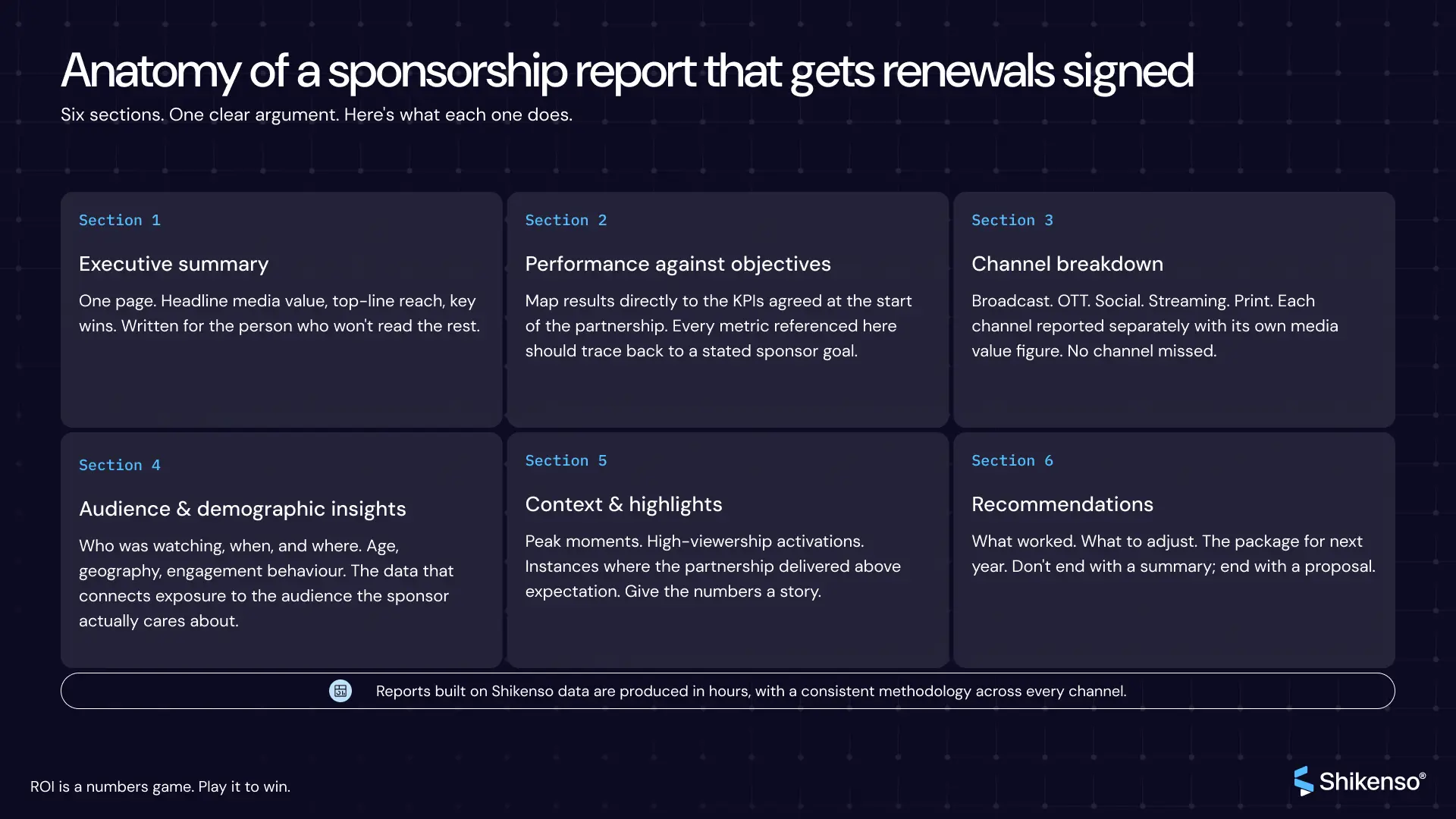
A report that earns renewals typically runs in this order:
- Executive summary: one page, key figures only, written for someone who won't read past page two
- Performance against stated objectives
- Channel breakdown with media value per platform
- Audience and demographic insights
- Recommendations for the year ahead
That final section is more important than most rights holders realise. Arriving at a renewal meeting with a clear forward proposal, what worked, what to adjust, what package is being recommended, turns a retrospective into a forward-looking commercial conversation.
Reports That Win Renewals Are Built That Way
A sponsorship report is a commercial document. The rights holders that treat it that way are the ones that walk into renewal meetings with the data, the narrative, and a forward proposal already in place.
That starts with having the right measurement infrastructure in place before the season ends. If you want to see how Shikenso structures sponsorship reporting across channels, we're happy to walk you through it.

Related reads




Get new insights straight to your inbox
Don’t miss out on the insights that the press and media rave about!