
Germany's biggest advertisers walked into their Berlin summit in November with better economic hopes and more divided budget plans. The OWM Trendbarometer, the annual member survey of the German advertisers' association, found more of them planning to raise budgets for 2027 and more of them planning to cut. The middle is shrinking.
What decides which side a channel lands on is proof. And German advertisers still name cross-channel proof of advertising effectiveness as their biggest challenge.
Sponsorship doesn't appear anywhere in that debate. That's a problem for brands that spend millions on it, and an opening for the ones that can show what it delivers.
What does the OWM Trendbarometer say about 2027?
The OWM Trendbarometer says German advertisers see a slightly better economy in 2027 but a market under pressure: 43% expect rising revenue, only 34% expect rising earnings, and budget plans are splitting into increases and cuts. Proof of advertising effectiveness across channels remains their top challenge.
The OWM Trendbarometer is the annual survey of the Organisation Werbungtreibende im Markenverband (OWM), the association of Germany's advertising companies. According to the OWM, its 111 member companies represent more than €12 billion in advertising investment, so the survey is a good read of where big German brand budgets are heading.
The 2026 edition was published on 3 November 2026 and presented at the OWM Summit in Berlin. The OWM press release sums it up in its headline: the economic outlook is improving slightly, but the advertising market stays under pressure.
The gap between those two numbers explains the budget picture. Companies expect to sell more but keep less of it, so every euro in the marketing plan gets a harder look.
Why are German advertising budgets for 2027 splitting?
German advertising budgets for 2027 are splitting because fewer OWM members expect to keep spending flat. Compared with last year, more companies plan to increase their budgets and more plan to cut them, which the OWM calls a polarisation of budget planning.
The survey doesn't publish the shares, so the size of each group is unknown. The direction is clear, though, and it matters more than the exact split. A flat budget protects every line in the plan. A polarised market doesn't: some budgets grow, some shrink, and the channels inside them get ranked against each other.
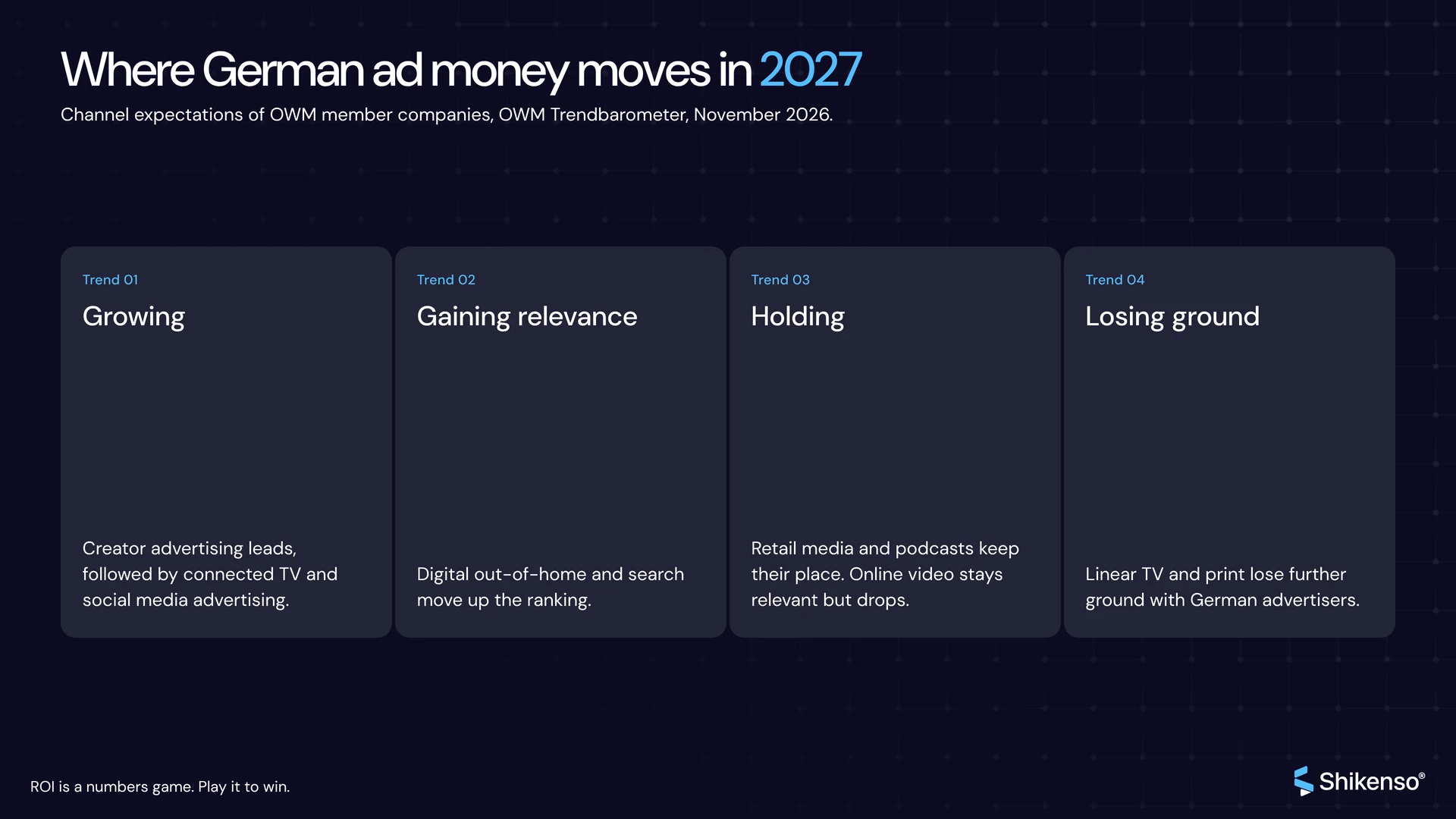
Where the money is expected to go also shifted. As MEEDIA reports from the survey, OWM members see these channel moves for 2027:
- Growing: creator advertising is the most important growth driver, followed by connected TV and social media advertising.
- Gaining relevance: digital out-of-home and search.
- Holding: retail media and podcasts keep their position; online video stays relevant but drops in the ranking.
- Losing: linear TV and print lose further ground.
Two things stand out for sponsorship teams. The fastest-growing channel, creator advertising, is one where sponsorship already shows up every day: athletes, streamers and fan creators post content with sponsor logos on shirts, boards and backdrops. And linear TV, where sponsorship exposure has always been easiest to count, is the channel advertisers expect to lose ground.
Why advertising effectiveness proof ranks first
Advertising effectiveness proof ranks first because German advertisers can't yet compare what their money achieves across channels. In the OWM Trendbarometer, cross-channel proof of effectiveness remains the top challenge, followed by cross-media measurement, with only slight shifts from last year.
The rest of the list, as LYDnews reports it, points the same way. Media fragmentation and reaching target groups remain central. AI in planning and buying, transparency in the media business, regulation and data protection are moving up.
The survey also says what advertisers expect from their partners. Vendors and platforms should deliver brand safety, fraud prevention and neutral proof of effectiveness. Auditors should be independent and neutral.
OWM managing director Susanne Kunz framed it as a competitive question: in fragmented, technology-driven markets, knowing how to deploy advertising investment and make its effect traceable is, in her word, "wettbewerbsentscheidend", decisive for competitiveness.
That standard, neutral and comparable across channels, is the one sponsorship will be judged by in 2027.
Why sponsorship is missing from the cross-media scorecard
Sponsorship is missing from the cross-media scorecard because most brands still report it separately: once a year, from the rights holder's recap, as one media value total that can't be set next to a CTV or creator campaign. The OWM channel list doesn't mention sponsorship at all.
That absence is odd given how sponsorship works. A shirt or perimeter board is seen in the live broadcast, in highlights and match clips, in news photos, on club and player social channels and in creator content. Sponsorship is cross-media by nature. It's just rarely measured that way.
It also reaches people other channels miss. The VSA, the German association of sports sponsorship providers, reports from the AWA 2026 media study that around 44 million people in Germany are interested in sport, and that two-thirds of people who deliberately avoid TV advertising are interested in sport. The VSA sells sponsorship, so read that as advocacy, but the underlying audience data comes from the AWA.
Our view: in a polarised 2027 budget round, a channel that can't be compared is a channel that gets cut. Sponsorship won't lose because it performs worse. It will lose because it's the one line on the scorecard with a different kind of number.
How brands can put sponsorship measurement on the same scorecard
Brands can put sponsorship on the same scorecard by measuring it like the channels it competes with: independently, across every channel where the logo appears, broken down by asset, and during the season. Four steps cover most of it.
- Measure every channel, not just TV. Count sponsor exposure in live broadcasts, streams, highlights, social posts, news coverage and creator content. The OWM's fastest-growing channel, creator advertising, is often where sponsorship exposure grows fastest too. Our guide to measuring creator and influencer ROI covers the creator side.
- Use neutral data. OWM members ask vendors for neutral proof of effectiveness. A rights holder's own recap isn't neutral, so measure exposure yourself or through an independent third party.
- Break media value down by asset and channel. A single total can't be compared with a CTV or creator line. Media value per asset (shirt, LED boards, athlete posts) and per channel can. The method behind it is set out in our guide to how media value is calculated.
- Report during the season. Budget decisions in a polarised market happen early. Results that arrive while the season runs can still shape the 2027 plan; a recap in June can't.
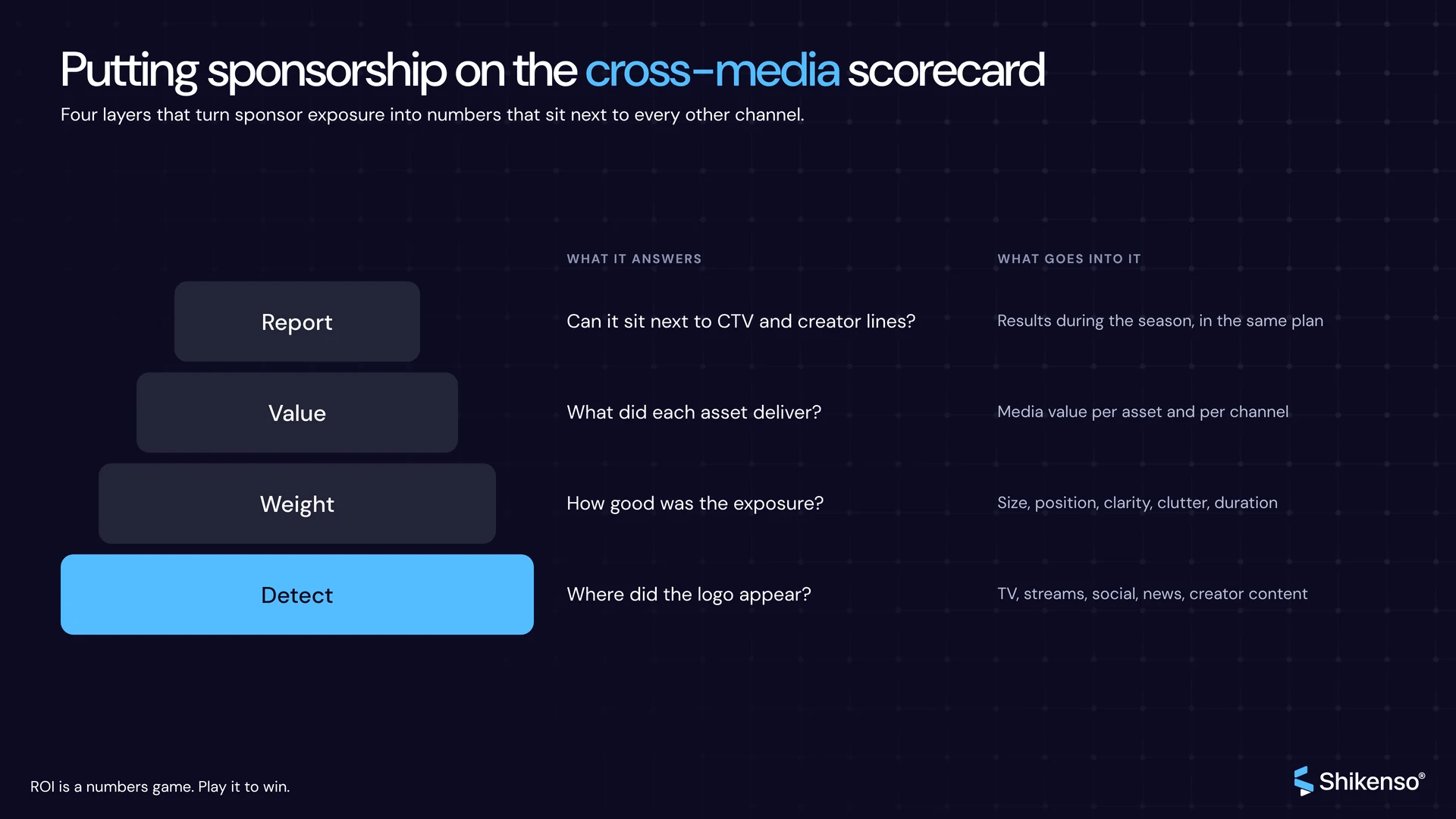
The diagram builds the same steps from the foundation up: detect every appearance, weight it for quality (size, position, clarity, clutter and duration), value it per asset and channel, then report it next to the other channels. Our complete guide to sponsorship measurement goes deeper on the outcome layers that follow, from engagement to brand and sales.
Shikenso measures sponsor exposure across TV, streams, social and online media with AI logo detection, independently of the rights holder, and breaks media value down by sponsorship asset and channel while the season is running.
What the OWM Trendbarometer means for sponsorship in 2027
The OWM Trendbarometer means sponsorship budgets in 2027 will be decided by the same question as every other channel: can the brand show what it delivered, in a form that compares with the rest of the plan? Three things we expect to follow from that.
- Sponsorship gets sorted, not trimmed. In a polarised market, deals with measured results move into the "grow" pile and unmeasured ones into the "cut" pile. Flat renewals become rarer.
- Creator content counts towards sponsorship value. As creator advertising grows, brands will start counting the creator clips that show their shirt or board as part of the deal's delivery, not as a bonus.
- Procurement asks for neutral measurement. The OWM already expects neutral proof from media vendors. Procurement teams will apply the same expectation to rights holders' recaps.
The Bottom Line
The OWM Trendbarometer describes a German advertising market that will grow some budgets and cut others in 2027, with proof of effectiveness deciding which is which. Sponsorship isn't on that scorecard yet. The brands that measure it independently, by asset and by channel, will defend their best partnerships when the budget splits. The time to start is before the 2027 plans are locked: put sponsorship on your scorecard.

Related reads



Get new insights straight to your inbox
Don’t miss out on the insights that the press and media rave about!