
The teams arriving at World Cup 2026 bring very different social media footprints. For brands evaluating where their sponsorship dollars go, those differences matter.
A national team account with 20 million followers on one platform can have almost no presence on another. A team that ranks 40th on Instagram might rank in the top 15 on TikTok. The number most commonly cited in a sponsorship deck, total followers, often compresses detail that actually drives activation decisions.
Across all 48 qualified teams, the gaps are wider than you might expect. This is the full breakdown, platform by platform.
The Overall Rankings: All 48 Teams
Summed across all 7 platforms, the range at World Cup 2026 is striking. France tops the table with 53.3M total followers, ahead of Brazil (43.3M) and Portugal (40M). At the other end, Curaçao, New Zealand, and Cape Verde each sit below 400K combined.
The top 10 is dominated by European and South American football powers. Morocco (12.2M) is the only African team in that group, and no Asian side cracks it. Mexico (30.9M) is the highest-ranked CONCACAF nation, sitting well ahead of the United States at 9.6M. The drop-off below the leaders is steep: the top 6 nations carry more combined followers than the other 42 put together.
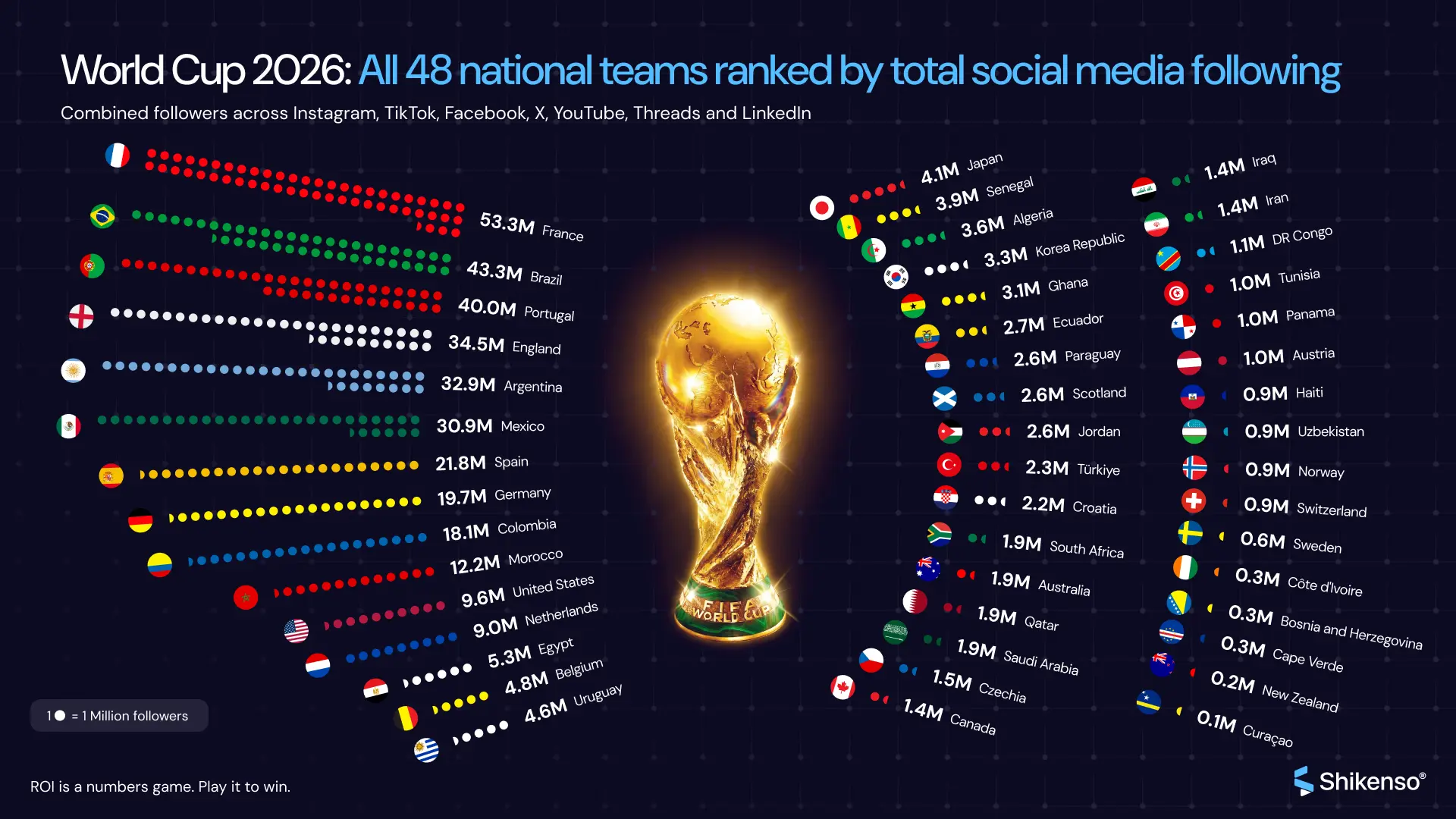
One number in that table deserves a second look. Norway sits 41st with 900K total followers, yet Erling Haaland's 40M Instagram following is larger than the Instagram account of any national team in the tournament. The aggregate total does not capture that, and it is exactly the kind of detail that shapes how smart brands structure their World Cup activations.
Social Following by Platform
Run the same ranking exercise channel by channel and the order shifts considerably. The team leading overall is not always the team leading where a given audience is actually paying attention.
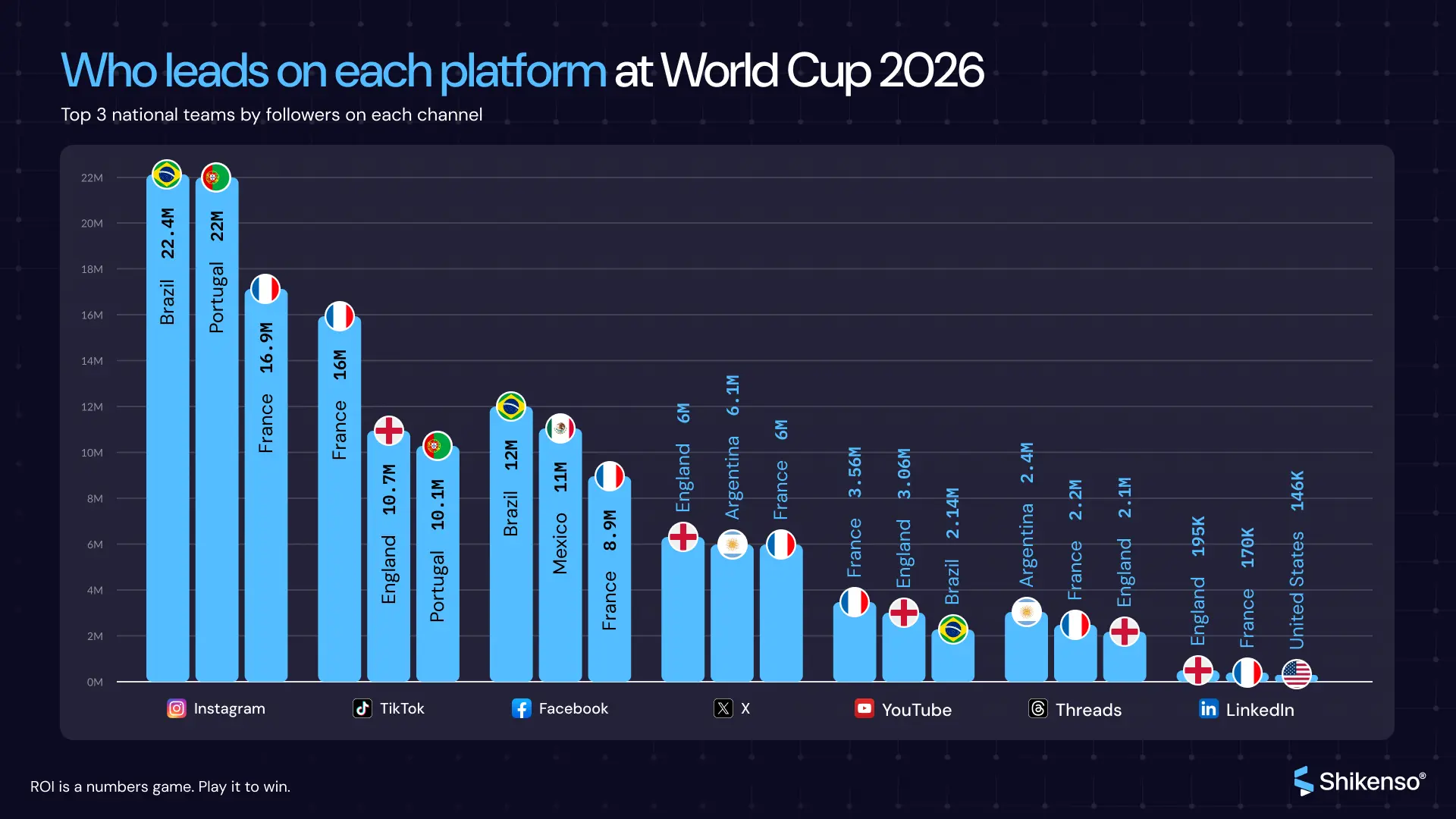
All 48 teams have an Instagram account, which makes it the only platform with the full field present. Brazil leads on 22M, with Portugal (21.7M) and France (16.8M) close behind. Sweden are the lowest-ranked European nation here, and New Zealand sit at the very bottom, a reflection of the distance between football's traditional markets and the newer nations brought in by the expanded 48-team format.
TikTok
France leads TikTok on 16M, ahead of England (10.7M) and Portugal (10.1M). TikTok is also FIFA's official video content partner for 2026, with exclusive rights to highlights, custom stickers, and in-app match information, which puts a spotlight on the platform's absentees.
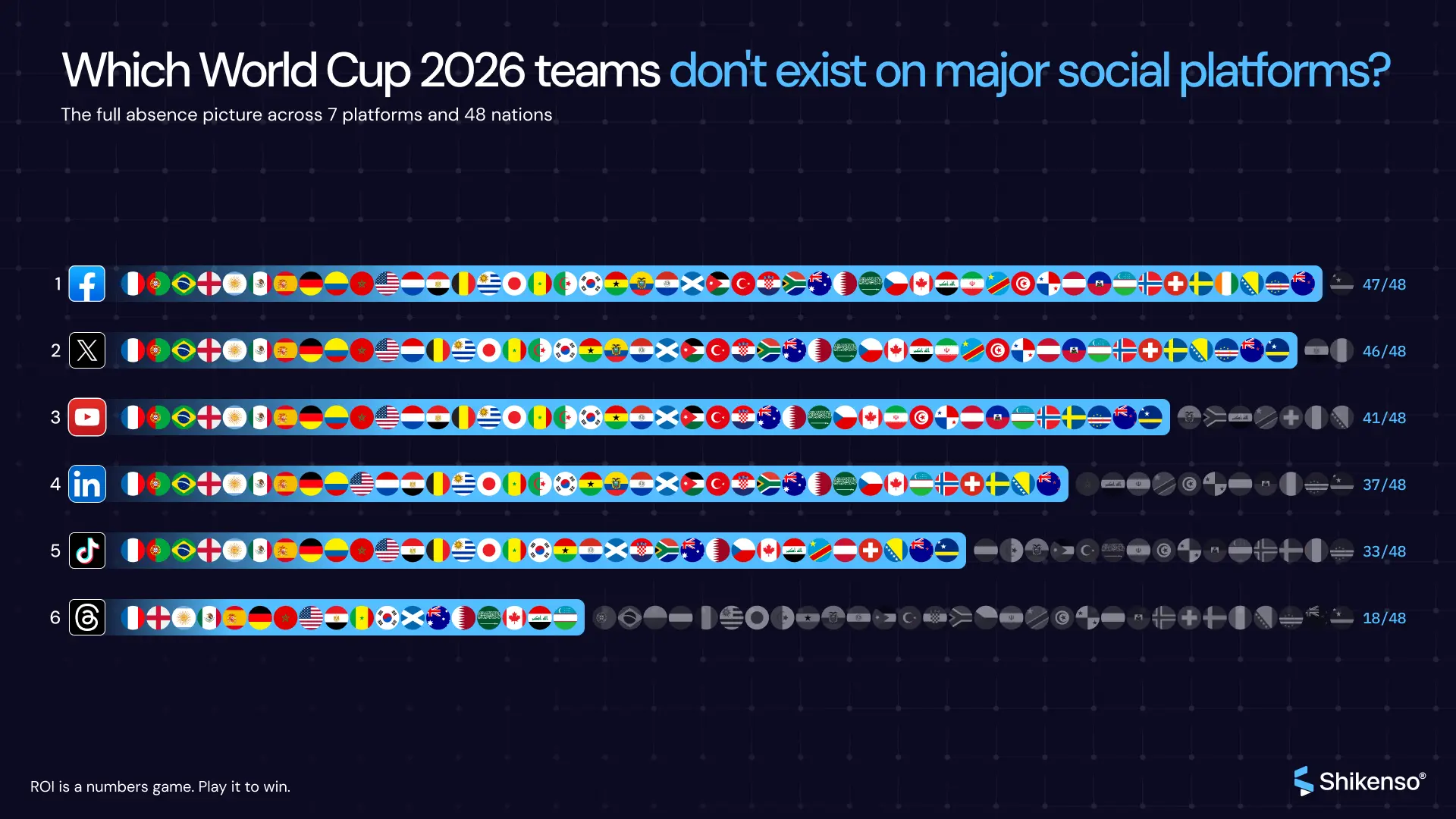
15 qualified teams have no TikTok account, and Norway are the sharpest example: they reach their first World Cup in a generation without one. Algeria carry 3M Instagram followers but have stayed off the platform where FIFA is now concentrating most of its digital attention.
X
Argentina leads X on 6.1M, with England and France just behind on 6M each. The platform runs deepest in European and Latin American football cultures, where live match commentary has always been central to fan behaviour. Egypt and Côte d'Ivoire are the only 2 qualified teams without an X account.
Brazil leads Facebook on 12M, followed by Mexico (11M) and France (8.9M). The platform still carries real weight in Latin America and sub-Saharan Africa, and only Curaçao has no Facebook presence among the 48.
YouTube
France leads YouTube on 3.5M subscribers, ahead of England (3.1M) and Brazil (2.1M). YouTube is where longer brand integrations live, the post-match content, documentary formats, and extended broadcast material that short-form platforms cannot hold. 7 teams have no channel at all.
Threads
Threads is the thinnest field. Only 18 of 48 teams have an account, and Argentina (2.4M) leads it, with France (2.2M) and England (2.1M) the only other nations above 1M. Portugal, Brazil, the Netherlands, Belgium, and Croatia are among the 30 with no presence there.
LinkedIn works as a commercial and partnership channel for federations rather than a fan-facing one, so the numbers stay modest across the board. England leads on 195K, ahead of France (170K) and the United States (146K). 11 teams have no account at all.
National Team vs Top Player: The Instagram Gap
For most countries at this tournament, the largest football audience a brand can reach sits with a player rather than the federation account.
The graphic below maps the official national team Instagram account against the squad's most-followed player for the 10 nations with the widest gaps. The gap column shows how many times larger the player's following is relative to the team.
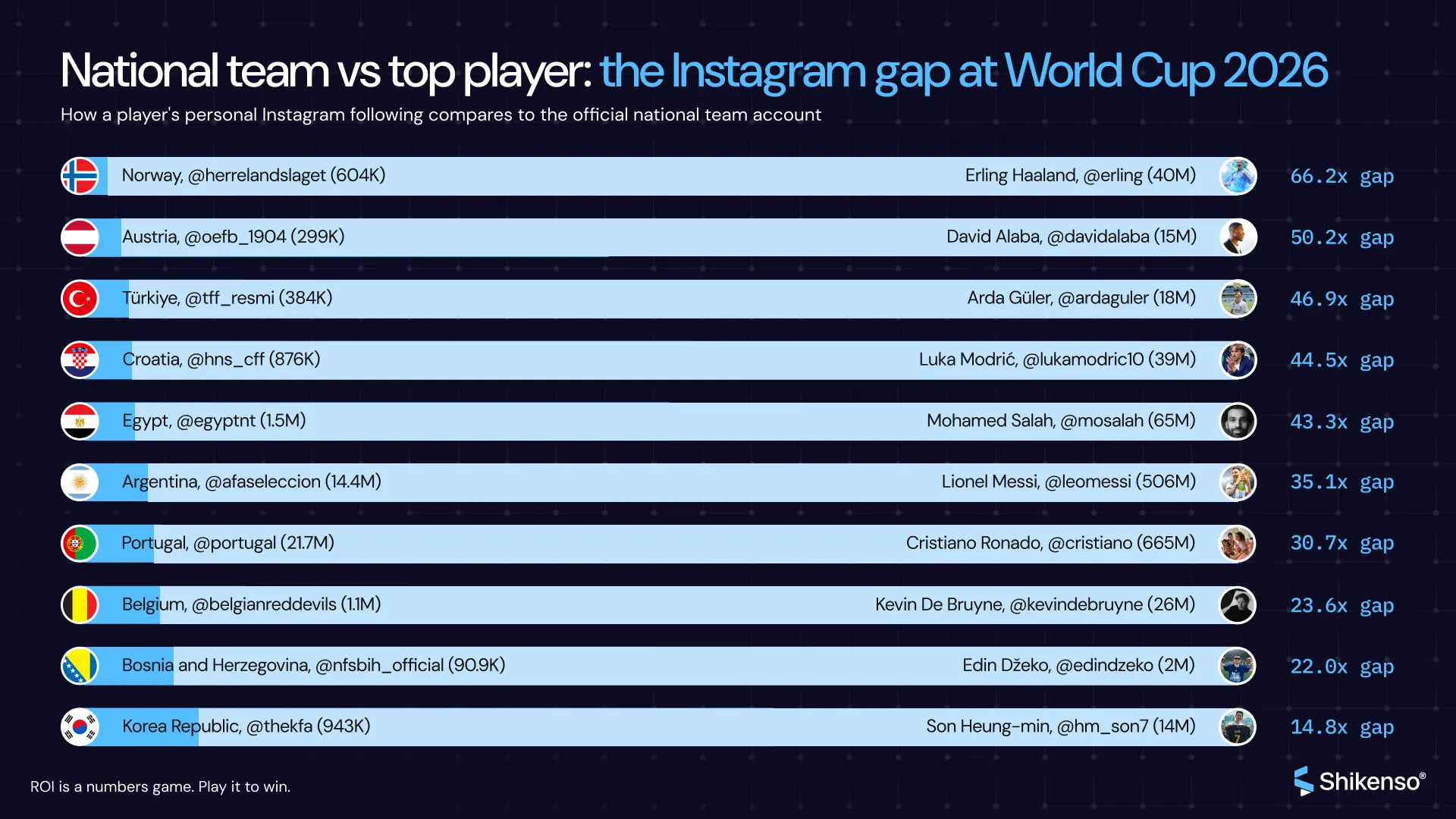
The widest gaps belong to Norway (66x), Austria (50x), Türkiye (47x), Croatia (45x), and Egypt (43x). These are nations where a commercially active football audience exists, yet it sits almost entirely in a player's personal account rather than the federation's. For a brand, that changes the buy: reaching those fans at scale means working through the player rather than the federation account.
Two federations sit at the opposite extreme. Germany's @dfb_team (7.2M) runs almost level with Jamal Musiala's personal account (7M), one of the few cases where a federation has built reach to match its biggest individual name. Mexico goes further still: @miseleccionmx (7.4M) is more than twice Raúl Jiménez's personal following, the product of sustained investment in the official channel.
Where Sponsorship Measurement Comes In
Follower counts across 7 platforms, spread over 48 nations with very different distribution patterns, produce a data landscape no single headline number can summarise.
A brand activating around a World Cup partnership needs to know which platforms carry the audience they are buying, and whether that audience sits on the official team account or on the personal accounts of individual players.
For brands investing in World Cup sponsorships, that question extends into measurement. A logo appearing in a broadcast clip shared at once across TikTok, YouTube, and Instagram generates exposure on all 3 channels, and what that exposure is actually worth on each one depends on placement, duration, and quality.
The platform gaps in this data are a signal too. 15 teams with no TikTok means no organic TikTok reach from those federations, regardless of the tournament's formal platform arrangements. A player's personal account might fill that gap, but that is a different commercial arrangement, with different measurement requirements, at a different price point.
These numbers reflect the landscape before a ball is kicked. Six weeks of football, with its upsets, breakthrough players, and viral moments, will shift them considerably. The teams with the biggest starting audiences are not always the ones that end the tournament with the most new followers.

Related reads
Get new insights straight to your inbox
Don’t miss out on the insights that the press and media rave about!