

Your dashboard says your logo appeared for 47 seconds.
Now what?
On its own, that number has no commercial meaning. 47 seconds compared to what benchmark? In front of which audience? During a penalty shootout or a quiet passage in the opening half?
Most sponsorship reports produce a number. Sponsorship intelligence gives that number a context and a direction.
"Sponsorship intelligence" appears on platform homepages, in RFP documents, and in agency decks — often used interchangeably with "data" or "reporting." Only 1 in 3 businesses has a standardised process for measuring their sponsorship investments, which means the majority are sitting on raw data with no clear framework for acting on it. At that trajectory, the commercial cost of unstructured measurement compounds each season.
This article defines what sponsorship intelligence actually means, where data and measurement fall short, and what it produces in practice.
Data, Measurement, and Intelligence: What's the Difference?
The three terms get used interchangeably. They describe three different things.
The jump from measurement to intelligence requires two things: context (what does this number mean against benchmarks, competitors, and your previous campaigns?) and speed (does the insight arrive while a decision can still be made?). Without both, measurement stays as measurement.
What Sponsorship Intelligence Actually Looks Like
In practice, sponsorship intelligence produces four distinct outputs that data and basic measurement cannot:
- Comparative context — a media value figure with no benchmark has limited use. Intelligence frames performance against category averages, against co-sponsors in the same deal, and against your own historical data. 22% above your tier average is a commercial argument; a raw figure with no reference point is harder to use in a renewal conversation.
- Asset-level insight — a jersey patch and a pitch-side board carry different media values and perform differently across broadcast versus social. Knowing the breakdown by asset type changes how the next deal gets structured.
- Audience alignment — exposure data shows total reach. Intelligence adds who the audience actually was — age, geography, and interest data that determines whether a sponsor's target demographic was watching at all.
- Performance direction — which assets are delivering stronger returns this season versus last? Which events are declining in commercial value? That forward-facing picture feeds directly into investment decisions.
Esports sponsorship accounted for more than 40% of total esports industry revenue in 2024. In a market where sponsorship drives that share of total revenue, the quality of intelligence available to teams and rights holders directly shapes what they can charge and how they prove value.
Why Data Alone Falls Short
Most organisations have data. The gap between data and intelligence comes down to three specific failures.
The context gap
A logo appearing for 90 seconds means different things in different situations. Was that above or below average for this tournament? How does it compare to your co-sponsors in the same broadcast window? Without benchmarks to frame the number, there's no basis for a verdict — and no argument to bring into a renewal conversation. A data point with no reference tells you an event occurred; it doesn't help you evaluate it.
The speed gap
Traditional manual sponsorship evaluation takes months of work per report. At season scale, that lag compounds across every event. Post-event recaps often arrive days or weeks after a broadcast has been consumed, shared, and archived. Any mid-campaign optimisation window closes long before the PDF lands. Shikenso delivers insights within hours of broadcast — the operational difference between a report that informs the next decision and one that documents the last one.
The channel gap
A sponsorship doesn't exist in one place. The same jersey patch appears in the live broadcast, in OTT highlight clips, in social media posts, and in press conference footage — each reaching a different audience at a different time. Data covering only the primary broadcast misses the full reach of that content downstream. Multi-channel reporting is where a media value figure becomes defensible, and where individual asset performance can be properly separated.
Find out where your data sits on this spectrum. Talk to the Shikenso team about what intelligence looks like for your sponsorship portfolio.
How AI Produces Intelligence at Scale
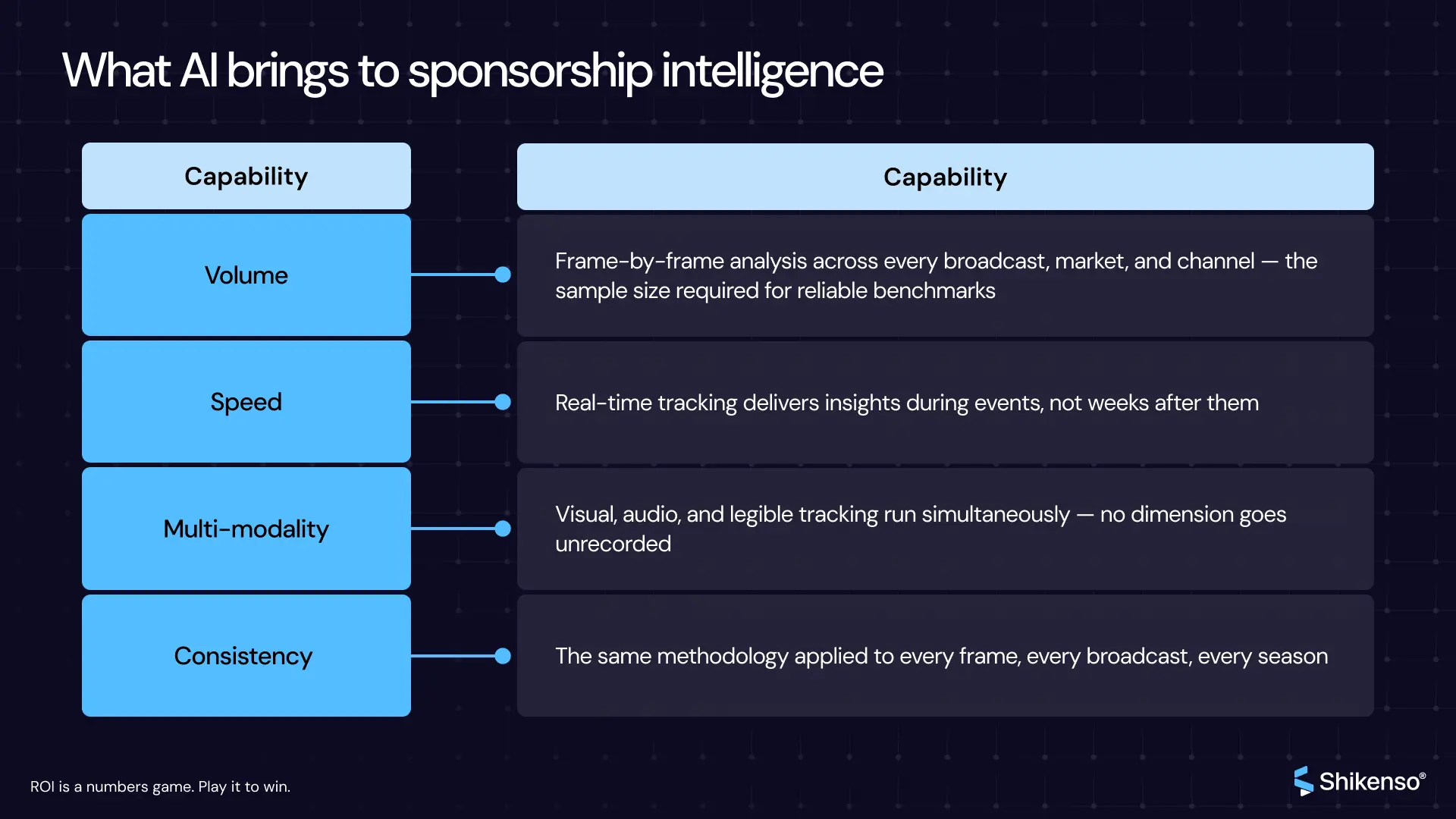
Converting raw data into usable intelligence across thousands of hours of content requires processing capacity that manual analysis cannot match. AI closes the gap in four areas:
- Volume — frame-by-frame analysis across every broadcast, every market, every channel. The sample size required for reliable benchmarks only comes from automated processing.
- Speed — real-time tracking means insights surface during events, not in a report that arrives weeks later.
- Multi-modality — visual, audio, and legible tracking run simultaneously. A brand mentioned in commentary and appearing in a broadcast lower third during the same 30-second window generates two separate data points, both captured.
- Consistency — the same methodology applied to every frame, every broadcast, every season. Human review introduces variable quality; the standard stays constant with AI.
Shikenso has been building on this technology since 2017 — well before AI became a standard feature claim in sponsorship analytics.
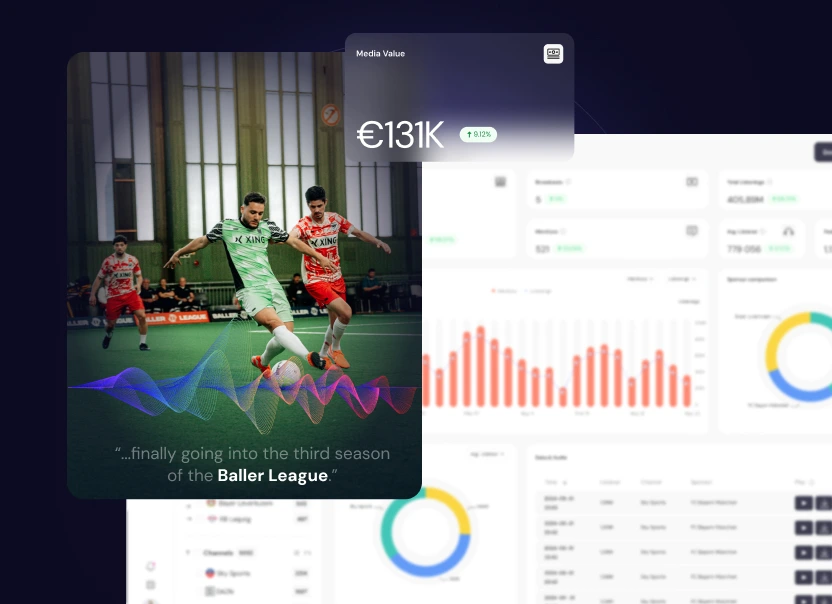
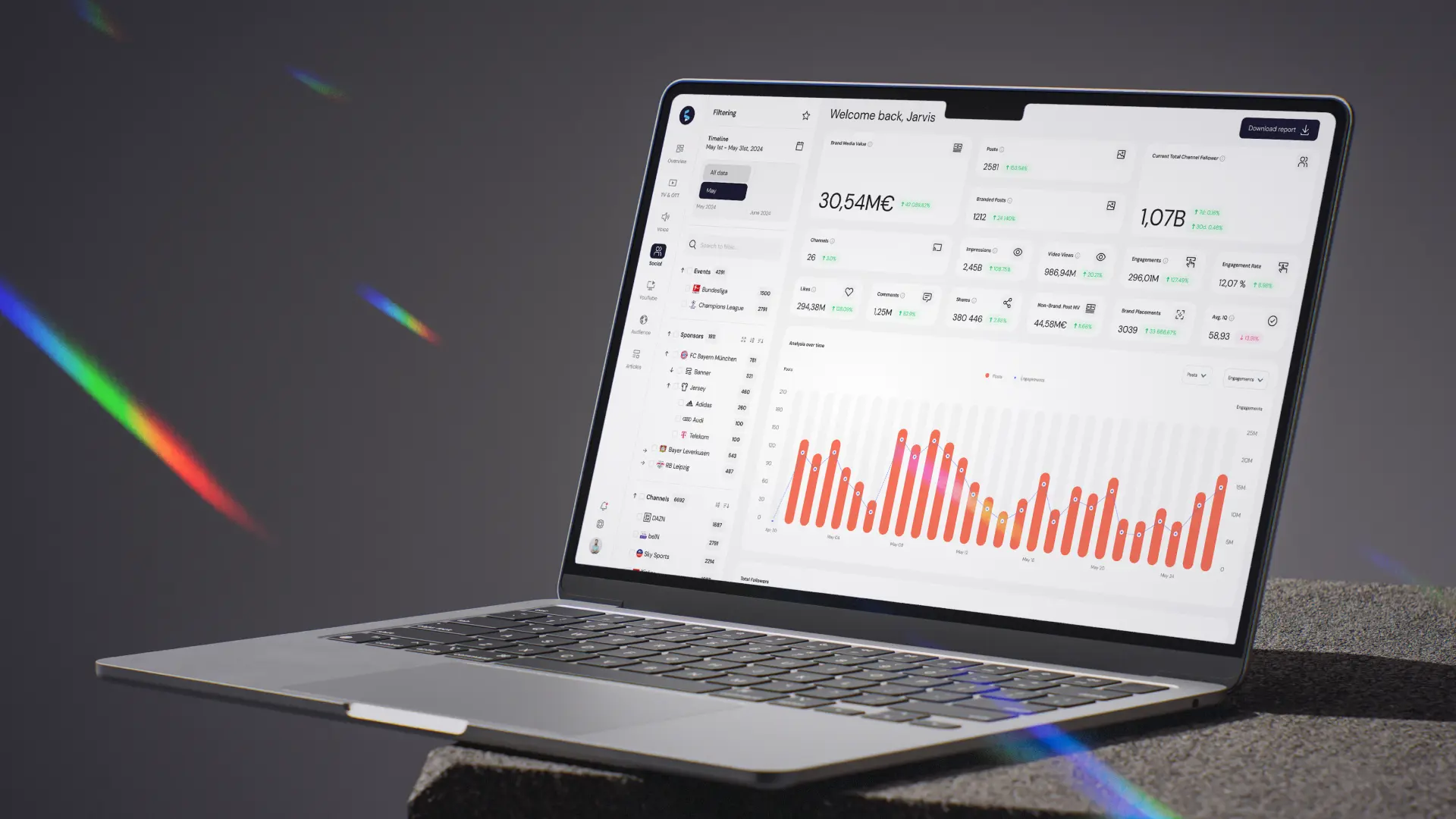
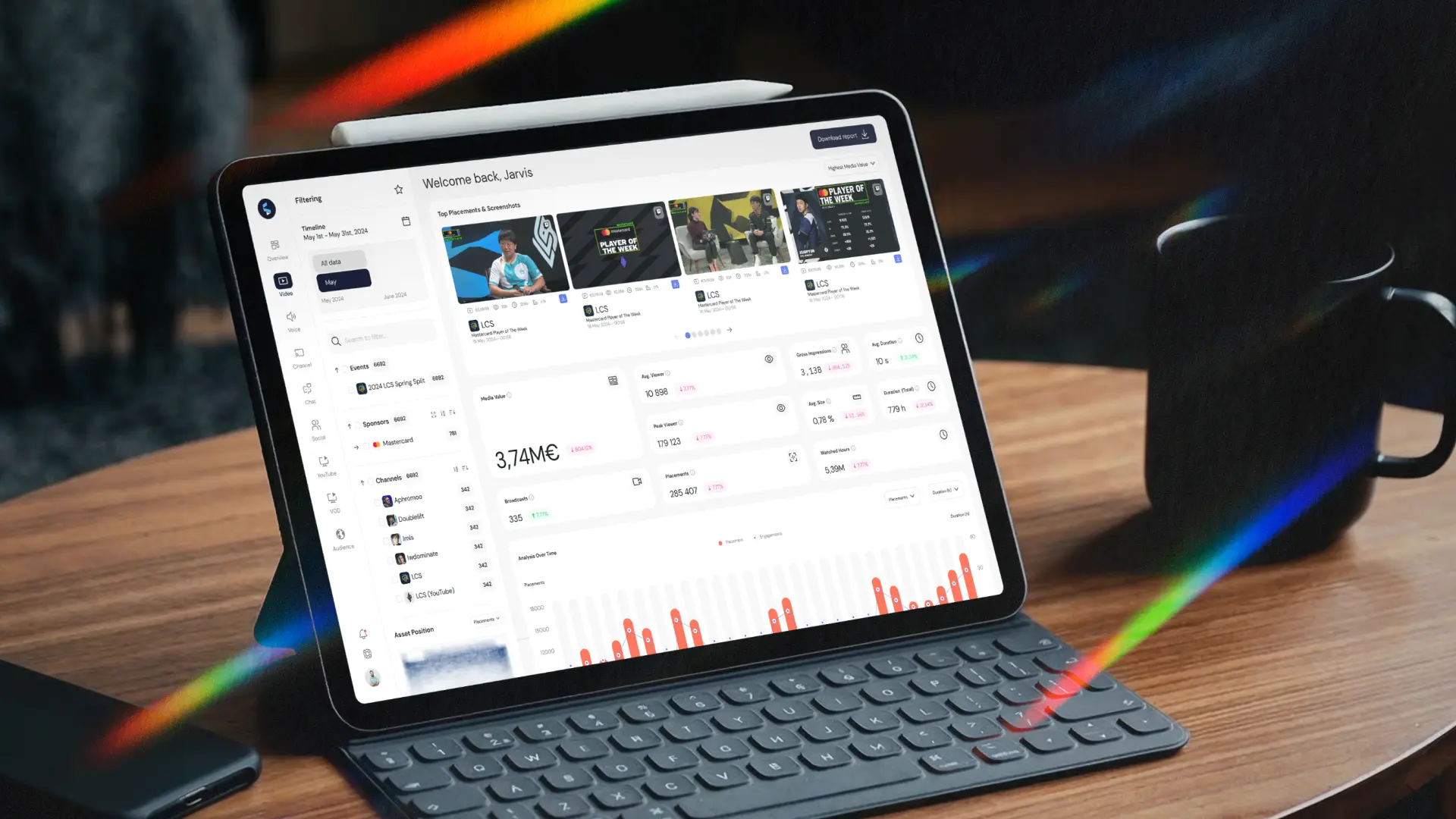
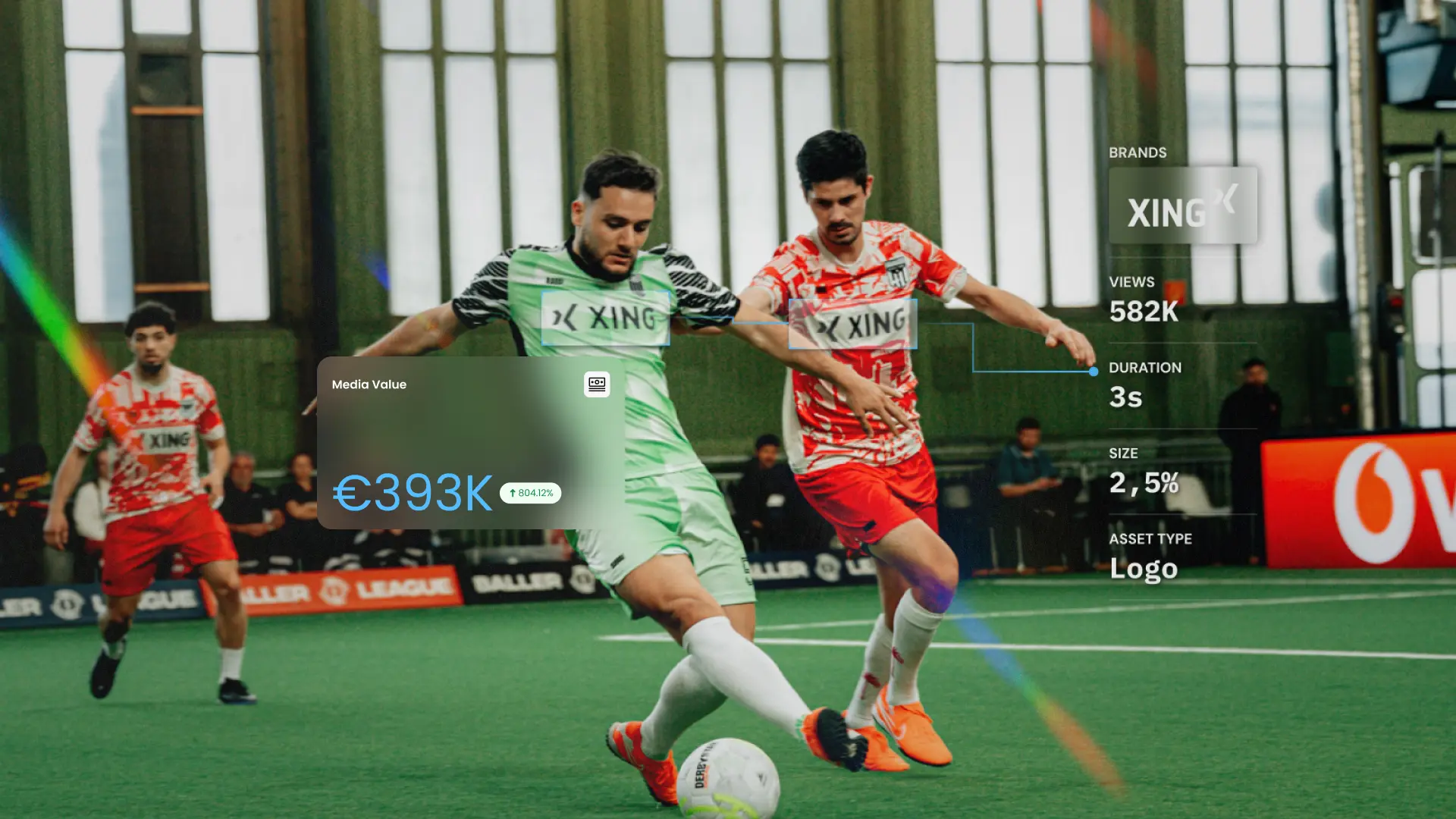
The practical expression of that capability is in how the data gets presented. Shikenso's dashboard lets users filter performance by campaign, sponsor, asset type, and time frame — and sort results by media value, placement, duration, or size. Benchmarks refresh automatically, so comparisons against historical data or category averages stay current without a manual update cycle.
Pulling a single sponsor's jersey patch performance across a six-month campaign, ranked by media value per broadcast window, is a filter selection rather than a reporting exercise.
Sponsorship Intelligence in Practice
Two examples from Shikenso's work show what intelligence produces at different scales.
When Shikenso partnered with the Belgian Pro League, unified intelligence needed to cover all 29 clubs — each with different broadcasters, different regional audiences, and different digital footprints. The output gave clubs a consistent media valuation across the full league structure, giving rights holders a data-backed basis for their commercial conversations with sponsors.
When MOONTON Games needed visibility across its global esports portfolio, multi-channel, multi-modal tracking identified €115 million in branded media value. That figure comes from measuring visual, audio, and text exposure across every market and every channel — the kind of number that logo counts alone could not produce.
Most organisations sit somewhere between data and measurement. Getting to intelligence requires three specific things: benchmarks that contextualise the numbers, reporting fast enough to act on, and coverage across every channel the content reaches.
Three questions worth running against your current reporting:
- Can you see which specific assets are delivering the highest return — and which are underperforming?
- Do your insights arrive in time to act on them, or only after the campaign has ended?
- Does your data cover every channel your content reaches, or just the primary broadcast?
A media value figure with no benchmark or audience context leaves a gap between what was measured and what can be decided. Sponsorship intelligence closes it.
See what sponsorship intelligence looks like in practice. We'll show you what your current sponsorship data is actually measuring — and where the gaps are.

Related reads


Get new insights straight to your inbox
Don’t miss out on the insights that the press and media rave about!