

Sports sponsorship is closing in on a €90 billion industry. Yet most of the brands putting money into it still can't say, with any confidence, whether it actually worked.
That gap — between the scale of investment and the clarity of results — is the ROI problem. And it's more common than people admit. Before you can solve it, you need to understand what sports sponsorship ROI actually means, what it covers, and why it's worth getting right for everyone at the table: brands, clubs, agencies, and rights holders alike.
What Is Sports Sponsorship ROI?
ROI — return on investment — in the context of sports sponsorship means the total value a brand receives from a partnership relative to what it spent. That sounds simple, but the definition of "value" is where things get complicated.
Unlike a paid digital ad where you can trace a click to a conversion, sports sponsorship works across multiple dimensions at once. A jersey logo seen by two million viewers during a match, a commentator saying your brand name at a key moment, a fan sharing post-match content that includes your LED board in the background — all of that is value. A proper ROI calculation needs to account for all of it.
Broadly, sports sponsorship ROI covers two categories:
- Tangible returns — media value, sales impact, lead generation
- Intangible returns — brand perception, audience affinity, long-term loyalty
Both matter. Neither should be dismissed in favour of the other.
What Does Sports Sponsorship ROI Actually Include?
Media Value
Media value is the monetary equivalent of the brand exposure a sponsorship generates. Put simply: what would it have cost to buy that same visibility through traditional advertising?
When your logo appears on a kit during a broadcast, that exposure has a calculable value based on:
- Audience size — how many people saw it
- Duration — how long the logo was visible on screen
- Placement quality — a chest sponsor on a jersey outperforms a background banner by a significant margin
- Channel rates — a premium broadcast commands a higher CPM than a regional stream
This is the metric that turns "we got great visibility" into an actual number your finance team can work with. We've written a full breakdown of how media value works and how it's calculated here.
Brand Awareness and Perception
Awareness is whether people recognise your brand after exposure to the sponsorship. Perception is whether they feel positively about it. The two are related but distinct — and both can be measured.
Pre- and post-campaign surveys track awareness shifts. Sentiment analysis tools monitor how audiences talk about your brand across social media, news channels, and live comment sections — categorising reactions as positive, neutral, or negative.
This matters because a sponsorship that generates huge visibility but negative audience sentiment is not delivering real ROI. One practical example: when a major beauty brand announced its partnership with a Formula 1 team, it was possible to analyse the immediate audience response across Instagram comments to understand whether fans of both brands were receptive — before any wider campaign spend was committed.
That kind of early signal is exactly what brand awareness measurement should deliver. More on how sentiment analysis works in sponsorship here.
Audience Engagement
Engagement covers how fans actively respond to a sponsorship: social media interactions, content shares, hashtag activity, and organic mentions that extend reach beyond the initial broadcast.
High engagement signals that the sponsorship is resonating. Audiences aren't just passively seeing the brand — they're reacting to it, talking about it, and amplifying it without being paid to do so.
Commercial Impact
This is the most direct line to revenue: sales uplifts, lead generation, and website traffic attributable to sponsorship activity. It's also the hardest metric to isolate cleanly.
There are rarely neat causal links between a logo on a jersey and a purchase decision. Long-term commercial impact tends to build over multiple seasons and requires sustained measurement to capture accurately — which is part of why so many brands underestimate the true value of their sponsorships.
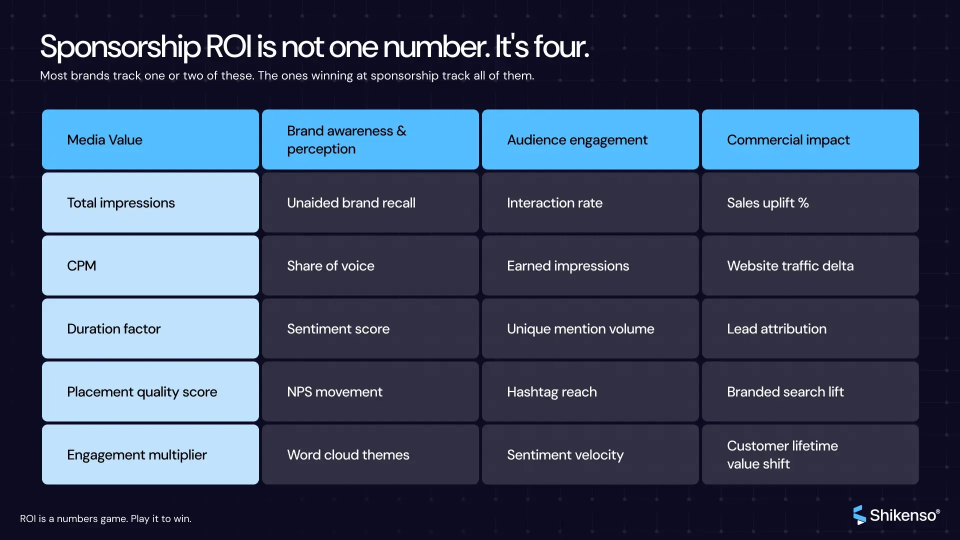
The framework below maps the specific metrics that sit under each component, and what each one is actually telling you.
Why Is It So Hard to Measure?
The short answer: sponsorships are inherently multi-channel and simultaneous.
A single matchday sees your brand appear on the broadcast, across social clips, in live commentary, in post-match coverage, and in fan-generated content — often all at once. That fragmentation makes unified measurement genuinely difficult.
The data backs this up. Only 19% of sponsorship professionals are confident they can actually measure the business value return on their investments. Also, brands attempting to measure sponsorship impact often use inaccurate models, resulting in a potential 68% error in their reported ROI.
In an industry where sponsorship spend can represent 15% or more of a total marketing budget, that is a substantial blind spot.
There's also the attribution challenge. Sponsorship builds brand equity gradually — the long-term effects on consumer behaviour often account for 47% of total sponsorship impact. That kind of value doesn't show up in a post-campaign dashboard two weeks after a tournament ends.
What has changed significantly is the technology. AI-powered measurement now scans broadcast, streaming, and social channels simultaneously — capturing:
- Visual logo appearances, frame by frame
- Audio mentions across 200+ languages
- Text activity across live chat and social platforms
The table below shows exactly how that shift from active to passive data changes what gets measured — and how reliably.
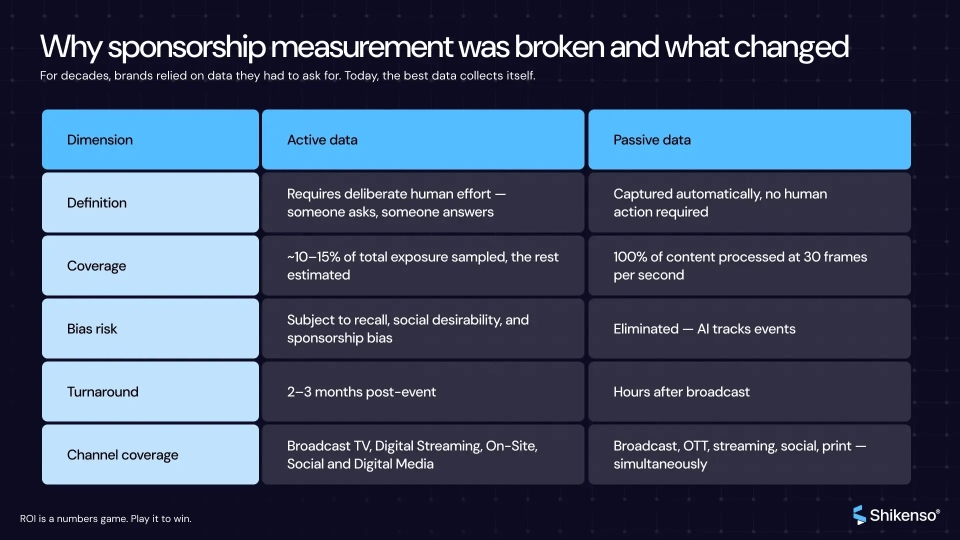
Tracking these channels manually was never feasible at scale. The shift to automated, real-tim measurement means far less exposure goes unaccounted for, and far fewer euros in media value go unreported.
Why It Matters — For Brands and Rights Holders
ROI measurement isn't just a post-campaign exercise. It's what makes the entire sponsorship ecosystem function properly — and the stakes are different depending on which side of the deal you're on.
For brands, ROI data is what justifies budget renewal internally. Without it, sponsorship sits in the "feel-good spend" category — the first thing cut when marketing budgets tighten. With concrete data, brands can compare sponsorship performance directly against other channels in their marketing mix and make genuinely informed decisions about where to invest next.
For rights holders, clubs, and teams, understanding the ROI your partners are generating is a commercial asset. If you can demonstrate — with data — the media value and audience reach delivered to current sponsors, that's a credible, evidence-based tool in renewal negotiations and new partner conversations.
Rights holders who can show prospective sponsors real performance benchmarks close deals faster and at higher values than those relying on reach estimates alone. The two-sided nature of ROI measurement is what makes it strategically important — it shapes the commercial relationship between brands and properties at every stage of the partnership lifecycle.
What Does Good ROI Look Like?
There's no universal number, but the commonly cited benchmark is a 2:1 return — €200 in value for every €100 invested. Well-executed programmes regularly reach 3:1 or 4:1.
That said, the right benchmark depends entirely on what the brand set out to achieve:
- A brand entering a new market and building awareness from zero has different success criteria than one driving measurable sales in an established territory
- A brand focused on shifting brand perception should be measuring sentiment movement, not media value alone
- A brand targeting direct commercial return needs conversion data, not just impressions
The question isn't whether you hit a specific ratio — it's whether the outcome matched the objective defined before the partnership began. That's exactly why measurement needs to start at the strategy stage, not after the final whistle.
Measurement Is the Standard
Sports sponsorship ROI is not a single figure. It's a complete picture — media value, audience perception, engagement, and commercial impact — that together tells you what a partnership actually delivered.
The brands and rights holders getting this right treat measurement as part of the strategy from day one, not a report that arrives three months after the event. In an industry moving toward real-time data and transparent accountability, the ability to quantify what your sponsorship delivered is no longer a nice-to-have.
It's the baseline expectation.

Related reads



Get new insights straight to your inbox
Don’t miss out on the insights that the press and media rave about!