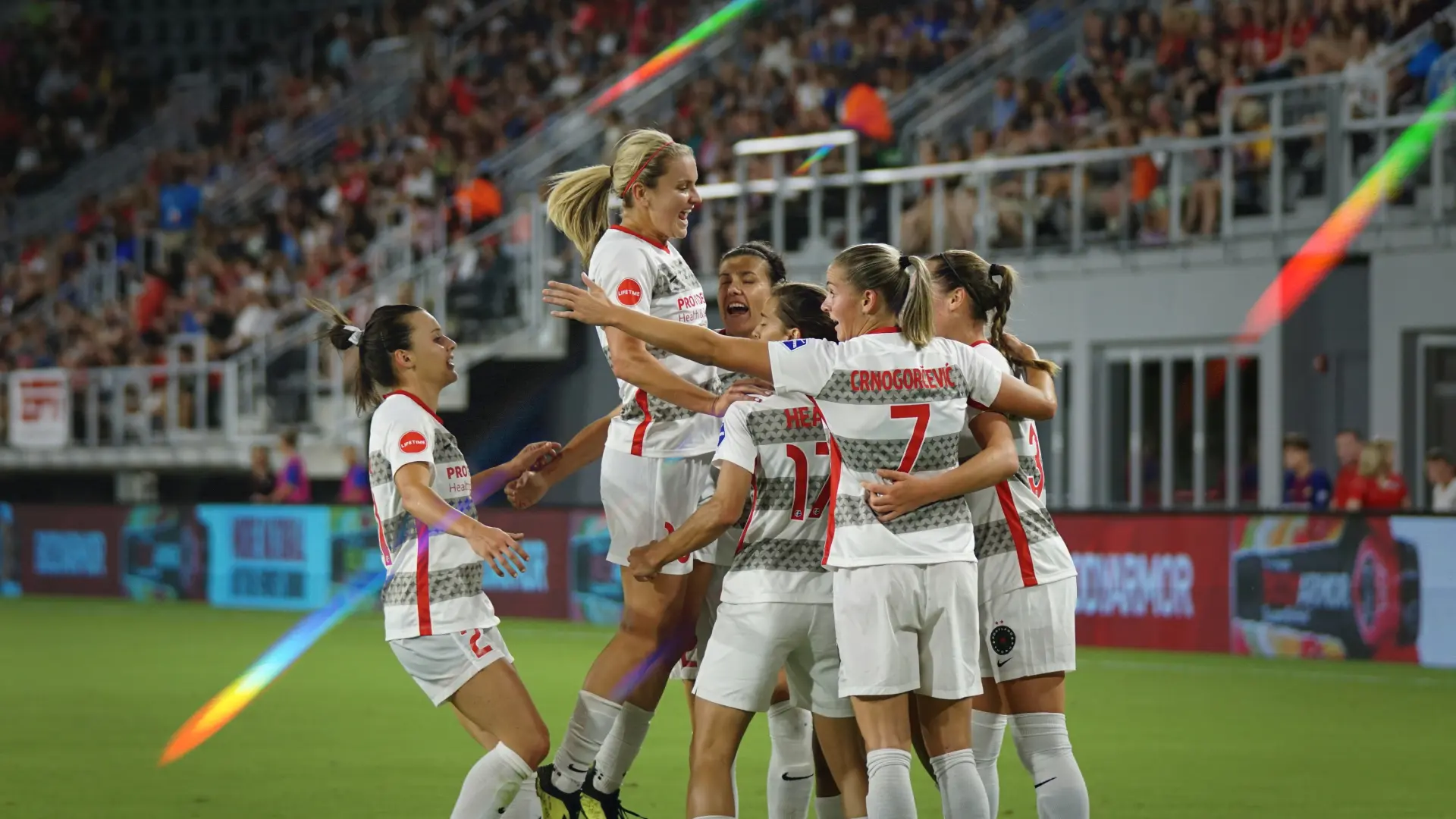

Women's football sponsorship in Europe has crossed a commercial milestone. Combined revenue across the top 15 clubs exceeded €100 million in 2023/24, representing 35% year-on-year growth. At tournament level, UEFA Women's EURO 2025 sponsorship revenue increased 112% compared to 2022.
Growth velocity in women's football sponsorship now outpaces men's competitions. Entry costs remain a fraction of equivalent men's inventory, yet pricing is tightening as brand interest accelerates. Early movers secured position 18 months ago. Brands entering later face materially higher premiums.
Europe's Four-League Market
The top four domestic leagues delivered 24% collective attendance growth in 2023/24, strengthening the commercial foundation for women's football sponsorship across Europe.
At club level, women's football sponsorship is already driving meaningful revenue. FC Barcelona Femení and Arsenal Women each generated €17.9 million in 2023/24. Arsenal's figures illustrate the pace of monetisation: matchday revenue rose 64%, while commercial income increased 48%.
League maturity varies:
- WSL: 7,308 average attendance, 41% growth
- Liga F: 1,501 average attendance, 11% growth
- Frauen-Bundesliga: 2,894 average attendance, 6% growth
- D1 Féminine: 38% growth from a smaller base
The WSL shows what structured investment delivers. The other leagues highlight where women's football sponsorship accelerates fastest from lower bases. Each market requires a different entry strategy.
What the Numbers Mean
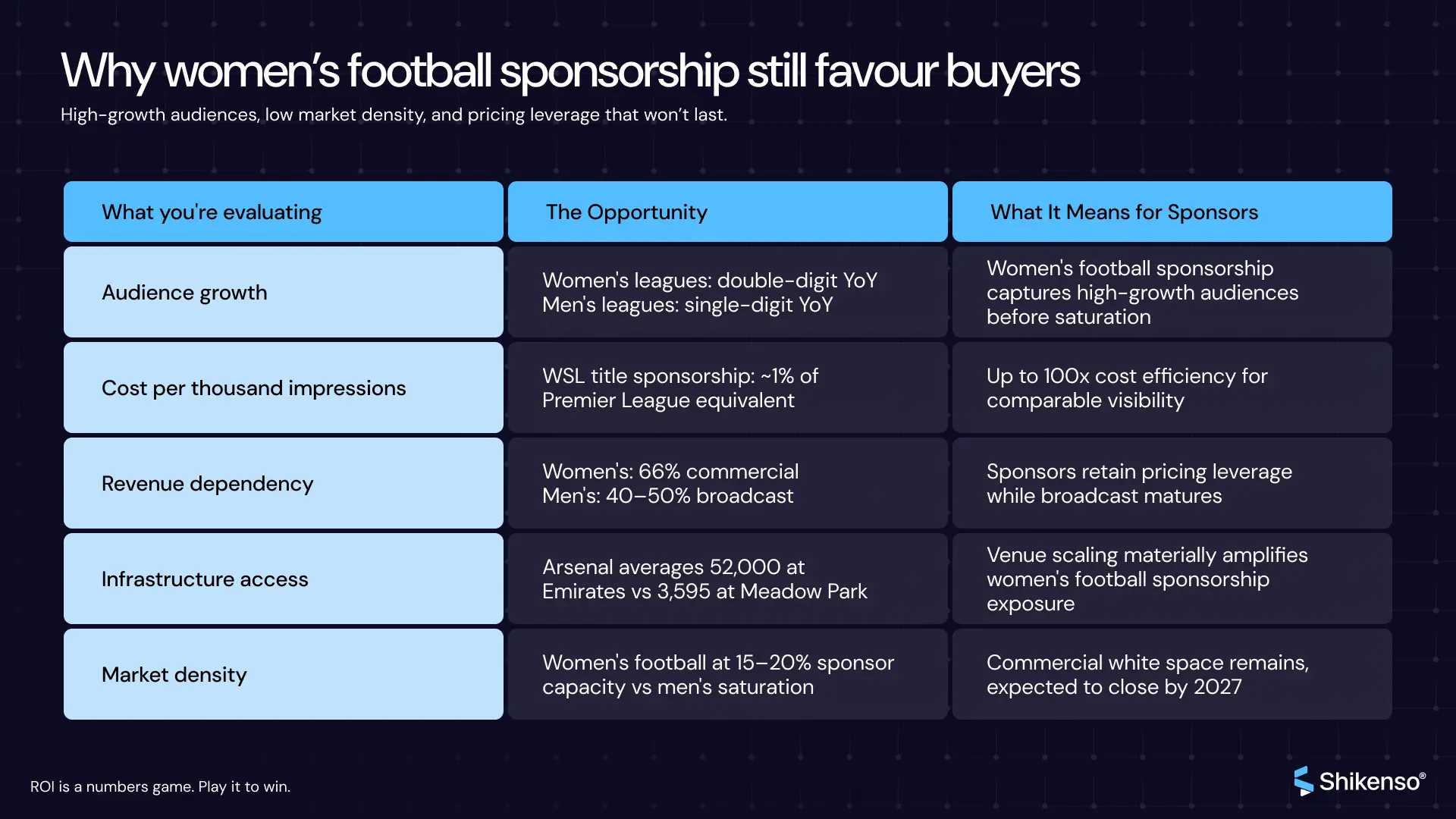
Bundesliga matches average 38,656 attendees, compared to 2,894 in the Frauen-Bundesliga. The women's competition continues to grow at double-digit rates while the men's league adds incremental gains. For women's football sponsorship, growth velocity delivers stronger future value than absolute scale.
Commercial revenue already represents 66% of women's club income. Men's top-tier clubs operate broadcast-heavy models. Until broadcast deals mature, women's football sponsorship remains sponsor-led.
League-Level Women's Football Sponsorship Is Repricing Fast
Barclays' WSL title deal doubled to €15 million annually at renewal. Three years ago, women's teams were commonly bundled into men's sponsorship packages. Today, 38% of women's clubs secure standalone main sponsors, reflecting the maturation of women's football sponsorship inventory.
All five major European leagues now hold multi-year broadcast agreements and title sponsors. This unbundling allows brands to assess women's football sponsorship independently, rather than as an extension of men's deals.
Across active partnerships, rights holders that secured women's football sponsorship agreements 18 months ago are renewing at materially higher valuations. Brands entering today face higher pricing. Delays continue to compound cost.
Tournament Sponsorship Validates Women's Football Sponsorship at Scale
UEFA Women's EURO 2025 attracted more than 20 sponsors, double the 2022 total. Revenue reached €33 million, up 145% year-on-year, with a €41 million prize fund across 16 teams. Men's EURO 2024 distributed €331 million across 24 teams.
The commercial gap remains wide. The speed at which women's football sponsorship closes it defines the opportunity.
The UEFA Women's Champions League reinforces this dynamic. All seven non-English clubs in top 15 featured in the UWCL group stage, offering tournament-level women's football sponsorship exposure that domestic leagues cannot always match.
Why Women's Football Sponsorship Still Faces Internal Resistance
The performance is there. Pricing still works. Renewal rates now mirror men’s sport. Yet adoption keeps stalling at the same point: internal evaluation. And the reason is consistent—measurement gaps that refuse to disappear:
- 56% cite brand awareness as a key objective, yet only 44% track it systematically
- 31% identify ROI evaluation as the most difficult stage of sponsorship deals
- 21% struggle to communicate value internally
Most valuation frameworks were designed for men’s sport. When applied to women’s football sponsorship, they overweight raw impressions and miss what actually drives value: engagement quality, audience composition, and brand affinity.
The results tell a different story. 86% of sponsors say their women’s football sponsorship meets or exceeds ROI expectations, with 32% outperforming projections.
The value is proven. Measurement is the bottleneck.
Measurement Infrastructure That Accelerates Women's Football Sponsorship Deals
We built our sponsorship analytics platform to close proof gaps in women’s football sponsorship. The system tracks visible, audible, and legible brand exposure across broadcast, social, digital, and print channels in real time.
This changes how decisions are made. Rights holders shorten deal cycles. Brands see exactly what was delivered. Renewals are based on board-level data, not anecdotal feedback. Automated reporting removes weeks from evaluation timelines.
With ROI clearly defined, sponsorship becomes a commercial lever rather than a risk.
The Pricing Window Is Closing
Barclays’ €15 million WSL deal still sits at roughly 1% of a Premier League equivalent. Arsenal Women’s €17.9 million in total revenue matches what a single men’s kit sponsor can deliver. Cost per impression in women’s football sponsorship remains up to 100x more efficient than in men’s competitions. That gap is closing.
Eighty percent of brand decision-makers plan to invest in women’s sport within three years, with 55% targeting women’s football specifically. UEFA projects European women’s football to reach €686 million in commercial value by 2033.
As inventory fills, competition tightens and pricing power shifts.
Sustainability Risks in Women's Football Sponsorship
However, it is not all upside yet. No clubs reported profitability in 2022/23, with average wages-to-revenue at 106% compared to 59% for men’s top-20 clubs. Many teams are still investing ahead of income to accelerate growth, which introduces counterparty risk if subsidies shift.
Commercial revenue remains top-heavy. In Liga F, top-three fixtures draw 18 times the attendance of lower-half matches.
Elite women’s football sponsorship deals command premium valuations, while mid-table clubs operate on thinner margins. Risk varies materially by sponsorship structure.
Evaluation Framework for Women's Football Sponsorship
For brands evaluating where to commit budget, the right assessment goes beyond traditional media metrics:
- Growth velocity vs scale: 41% WSL attendance growth outpaces single-digit Bundesliga growth
- Pricing and timing: Current women's football sponsorship costs discount future value
- Infrastructure maturity: WSL demonstrates standalone capability, emerging leagues deliver acceleration
Audience composition
- Younger demographics
- Higher social engagement rates
- Digitally native fanbase
- 43% of women's sports fans are male
Partnership structure
- Club-level: High visibility with operational risk
- League-level: Broader reach with reduced exposure
- Tournament: Concentrated timing with elevated coverage
The Decision Point
Timing is the difference. Brands that moved 18 months ago are already renewing at higher valuations. Those entering now are paying more—and waiting longer only pushes the price up again. Inventory is still on the table, for now.
The market will decide who secured position early, and who ends up justifying premium spend once founding-rate women’s football sponsorship opportunities are gone.

Related reads




Get new insights straight to your inbox
Don’t miss out on the insights that the press and media rave about!