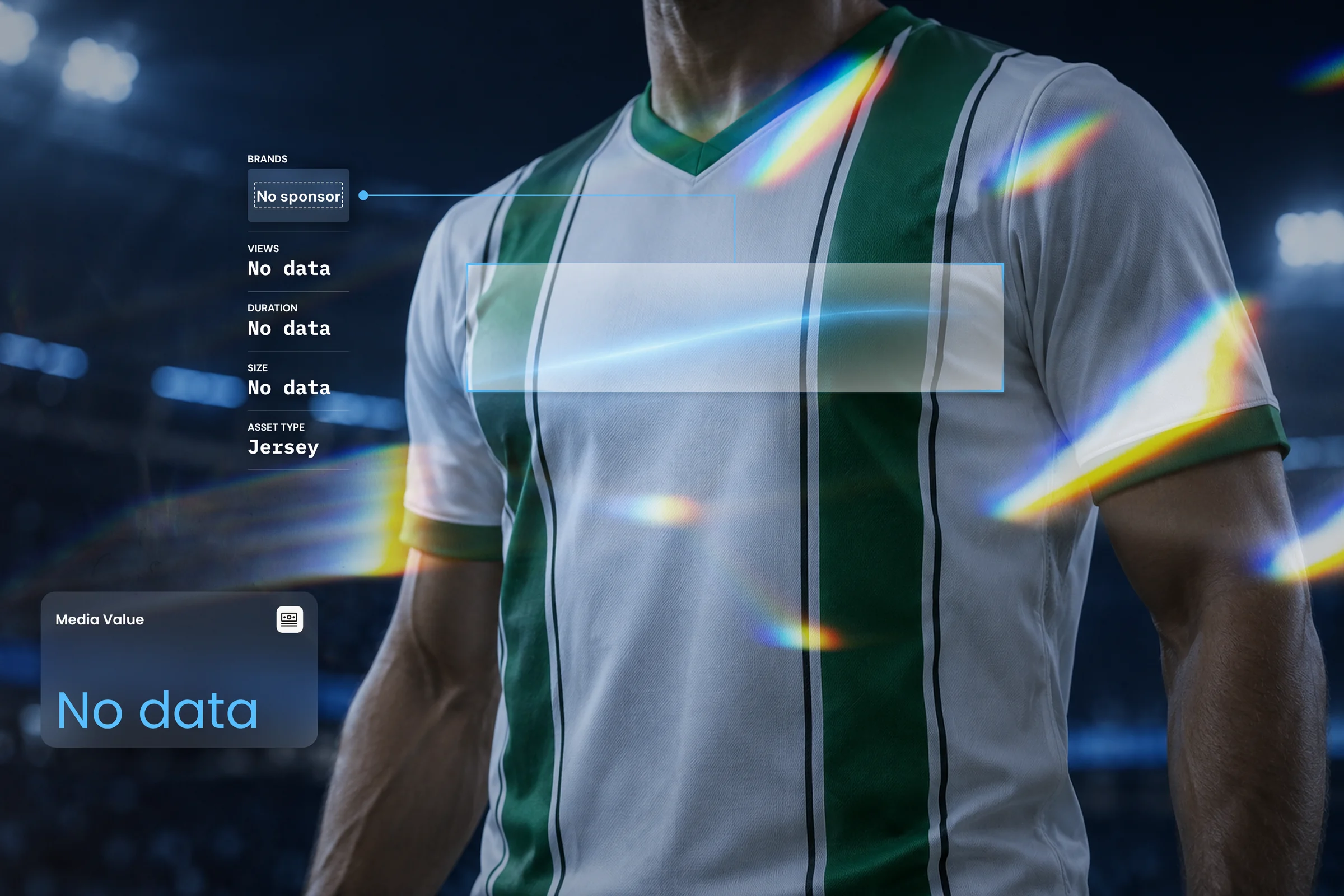

Borussia Mönchengladbach will need its 13th main shirt sponsor in club history. Reuter, the online bathroom retailer on the front of the shirt since 2024/25, ends its main sponsorship when the 2026/27 season finishes and steps back to co-sponsor. No successor has been named.
Whoever signs next will be handed a price by the club. The smarter move is to arrive with a number of your own. A Bundesliga shirt sponsorship valuation built on what Reuter's slot actually delivered over three seasons is the strongest negotiating position a new sponsor can have.
This article covers what to measure, how to turn it into a price range, and which clauses to ask for when the club is fighting at the wrong end of the table.
What happened with Gladbach's shirt sponsor?
Reuter will end its main shirt sponsorship of Borussia Mönchengladbach after the 2026/27 season, after three years on the front of the shirt, and stay with the club as a co-sponsor. Borussia Mönchengladbach confirmed the decision in October and, by early November, had not named a successor.
The relationship goes back a long way. According to absolutfussball, Reuter has worked with the club since 2011, became a co-sponsor in 2015 and replaced the online broker Flatex as main sponsor from 2024/25. The fee was reported in the high single-digit millions per season; kicker's figures, compiled by ran.de, put it at €8 million a year.
The timing is awkward for the club. When the news broke on 9 October 2026, Gladbach had no points from four Bundesliga matches, sat bottom of the table and had already changed head coach. After eight matchdays, Gladbach is still last, with four points, according to the official Bundesliga table. A few months earlier, ista became the first naming sponsor of Borussia-Park, so Gladbach's commercial team has recent negotiating practice.
The Gladbach shirt sponsor search is not an isolated case. Football Benchmark found that more than half of the clubs in Europe's big five leagues had not announced a 2026/27 main shirt sponsor by the end of April 2026. And some brands are committing for shorter periods: Eurowings extended its Borussia Dortmund partnership by one more season.
How much is a Bundesliga shirt sponsorship worth?
A Bundesliga shirt sponsorship costs between €2.5 million and €65 million a year in 2026/27, depending on the club. Outside the top three, most front-of-shirt deals fall between €5 million and €13 million, and Gladbach's €8 million sits in the middle of that band.
The figures come from kicker, as compiled by ran.de in July 2026. Bayern's deal with Deutsche Telekom is reported at €60 to 65 million, RB Leipzig's Red Bull deal at an estimated €35 million and Borussia Dortmund's Vodafone deal at €30 million. The chart below leaves those three out, because they would flatten every other bar.
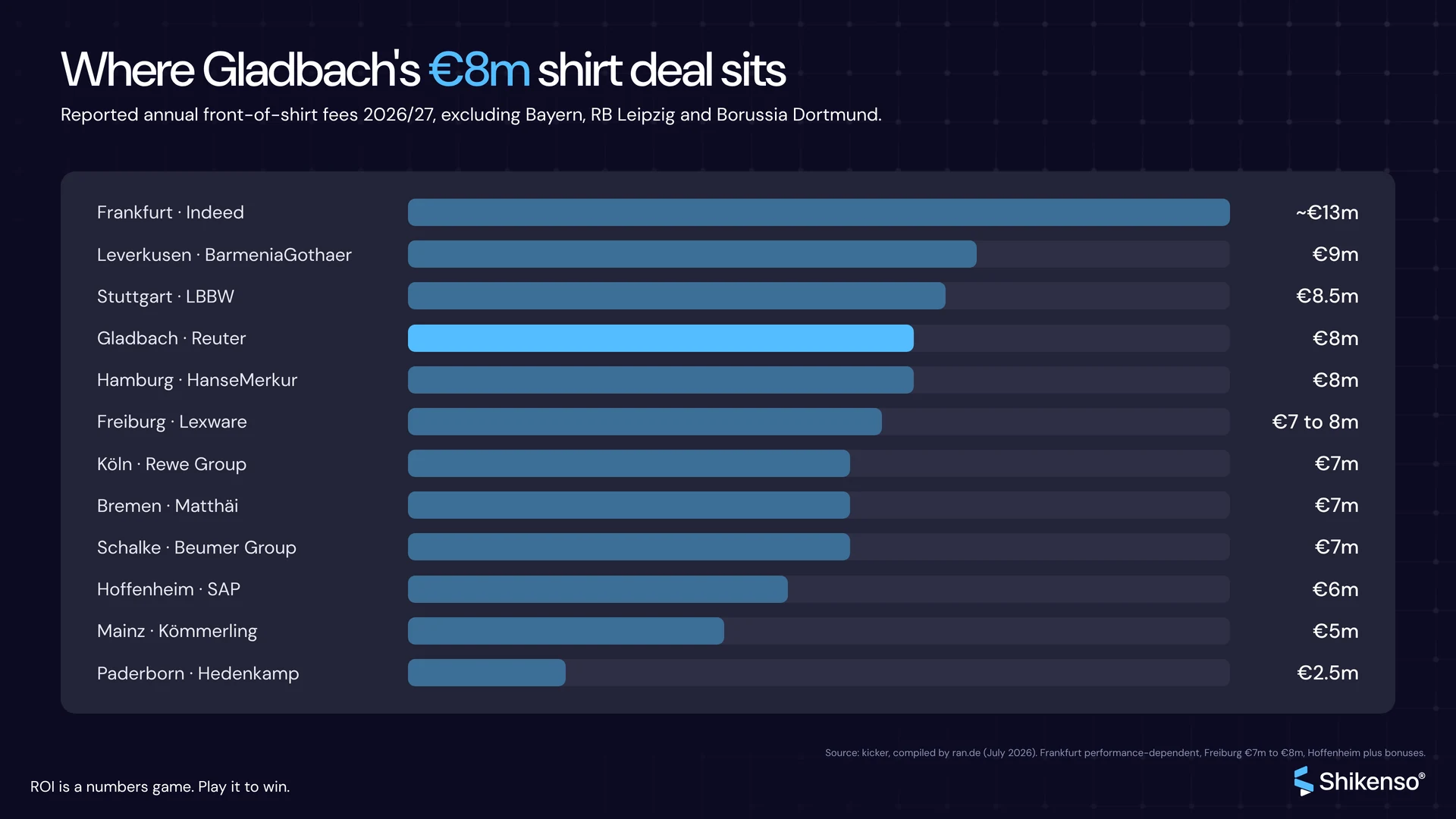
Below the top three, the reported annual fees are:
- Eintracht Frankfurt (Indeed): around €13 million, performance-dependent
- Bayer Leverkusen (BarmeniaGothaer): €9 million
- VfB Stuttgart (LBBW): €8.5 million
- Borussia Mönchengladbach (Reuter) and Hamburger SV (HanseMerkur): €8 million each
- SC Freiburg (Lexware): €7 to 8 million
- 1. FC Köln (Rewe Group), Werder Bremen (Matthäi) and Schalke 04 (Beumer Group): €7 million each
- TSG Hoffenheim (SAP): €6 million plus possible bonuses
- Mainz 05 (Kömmerling): €5 million
- SC Paderborn (Hedenkamp): €2.5 million
These numbers are prices, not values. A table of shirt fees tells you what other brands agreed to pay. It says nothing about what those slots delivered, and that gap is where a new sponsor's bargaining power lies.
Why the outgoing deal is the best benchmark
Bundesliga shirt sponsorship valuation is the process of estimating what a front-of-shirt slot is worth to a sponsor, based on the exposure it actually delivers, not only on what comparable clubs charge. For Gladbach, the best evidence already exists: three seasons of Reuter on the same shirt, in the same stadium, in front of the same fan base.
A fee table only tells you what the market agreed to pay. It can't tell you whether a slot over- or under-delivered against its price. Two shirts at €8 million can perform very differently: one club plays more prime-time matches and fills more highlight reels and match-report photos, another slides into a relegation fight and out of the headlines.
That's why we treat the outgoing deal as the starting point of any new negotiation. Reuter's seasons show how the slot performs in good runs and bad ones, which no league average, rate card or club pitch deck can.
What a retrospective shirt-slot audit measures
A retrospective shirt-slot audit measures the exposure a front-of-shirt logo actually delivered, season by season, across every channel where the shirt appears. For Gladbach, that means 2024/25, 2025/26 and 2026/27 so far, analysed in six layers.
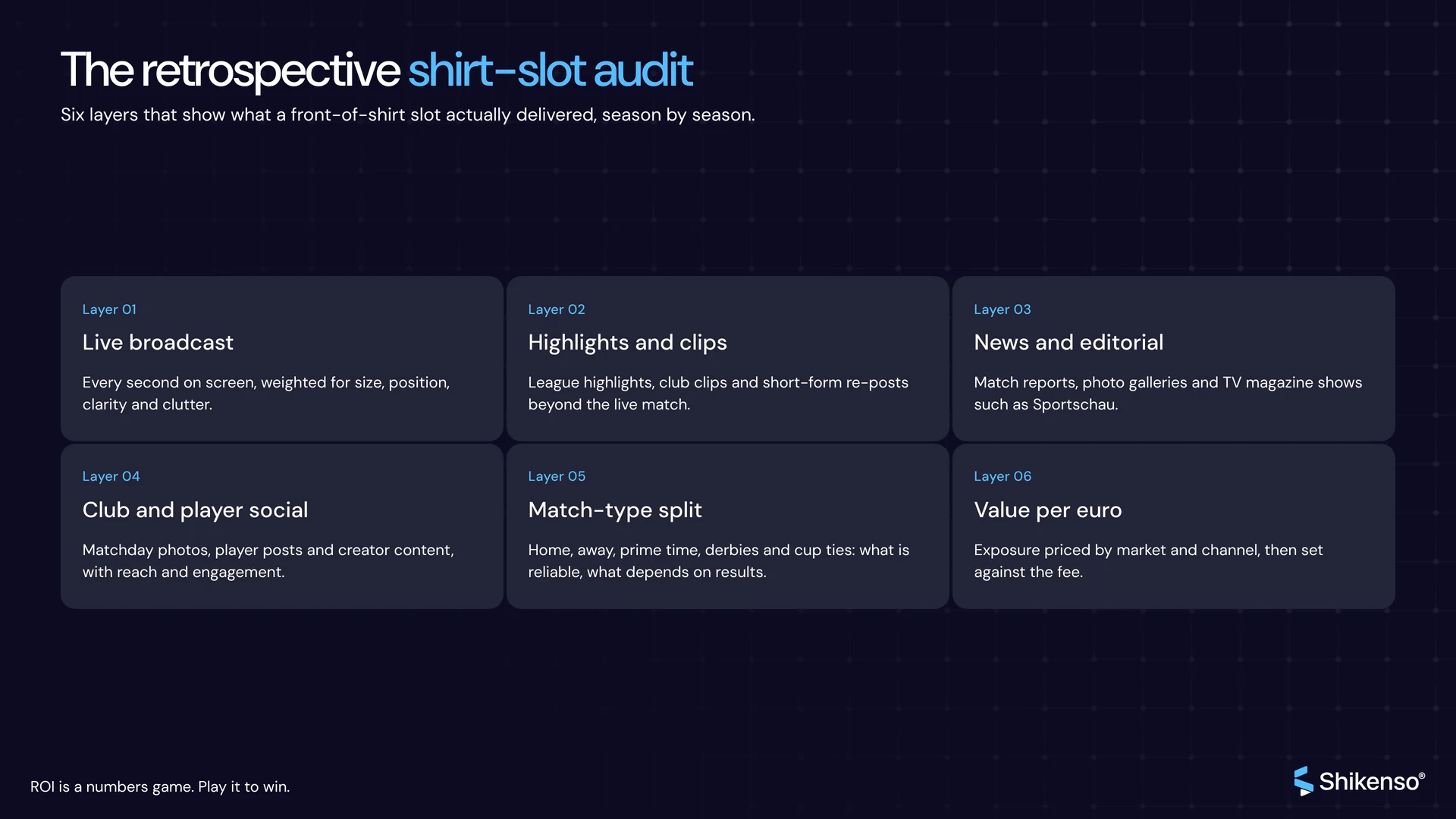
- Live broadcast. Every second the logo is visible in match coverage, weighted for size, position, clarity and clutter, the same quality weighting that logo detection applies in any channel.
- Highlights and clips. League highlights, club clips and short-form re-posts carry the shirt to audiences who never watch the full match.
- News and editorial coverage. Match reports and photo galleries on news sites, sports portals and newspapers, plus TV magazine shows such as ARD's Sportschau. The shirt appears in almost every match photo, often long after the final whistle.
- Club and player social. Matchday photos, player posts and creator content showing the shirt, with reach and engagement per post.
- Match-type split. Home and away, prime-time slots, derbies, cup ties. This shows which part of the slot's value is reliable and which depends on results.
- Value per euro. The total valued at market- and channel-specific prices, then set against the fee. Our guide to how media value is calculated covers the pricing logic.
The output of a shirt-slot audit is not one figure. It is a range with the drivers visible: how much value came from live TV, how much from news coverage and social, and how much depended on a good run of results.
How to build a Bundesliga shirt sponsorship valuation
A Bundesliga shirt sponsorship valuation turns the audit into a price range in four steps: set a floor from delivered exposure, model the upside, check the range against market fees, and write the result into a negotiation brief.
- Set the floor. Take the weakest of the audited seasons as your base case. It shows what the slot delivers when things go badly, and it is the part of the value you can pay for with confidence.
- Model the upside. Use the strongest season to estimate what a good year adds. That upside belongs in bonuses, not in the base fee.
- Check against the market. Compare your range with the fees in the table above. If the club asks for €8 million and the weakest season delivered clearly less, you have an evidenced reason to negotiate.
- Write the brief. List the base fee you would accept, the bonus triggers, the KPIs you will report on and the data you need from the club. Our guide to sponsorship KPIs helps you pick them.
Ask the club for its own exposure data as well. Many clubs already report to their partners, and a good sponsorship renewal report is a useful starting point. But a figure produced by the seller is not a figure your CFO will accept on its own. An independent audit, using the same method you will use during the deal, is what makes the price defensible.
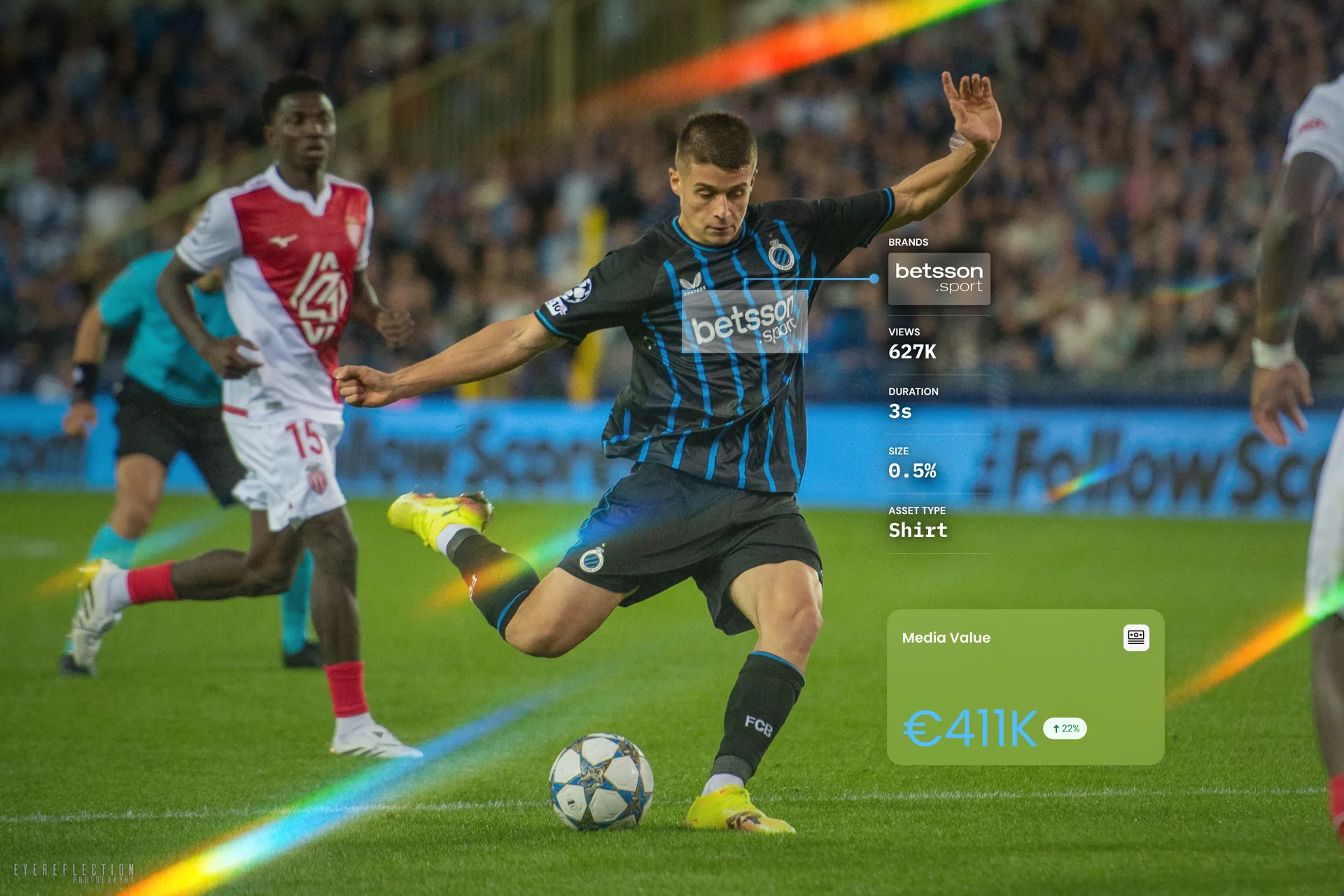
AI logo detection makes this practical at scale. It tracks every appearance of a logo across broadcasts, streams and social, so a sponsor can review a slot's history before signing and then measure the new deal with the same method. The example below shows what that looks like on a front-of-shirt logo.
Contract clauses for a volatile season
A volatile season calls for sponsorship contract clauses that move with the club's results. The Bundesliga already has examples. According to kicker's figures via ran.de, Schalke's deal with Beumer Group is worth €7 million in the Bundesliga and €3.5 million in the 2. Bundesliga, Eintracht Frankfurt's Indeed deal is performance-dependent and Hoffenheim's SAP deal includes possible bonuses.
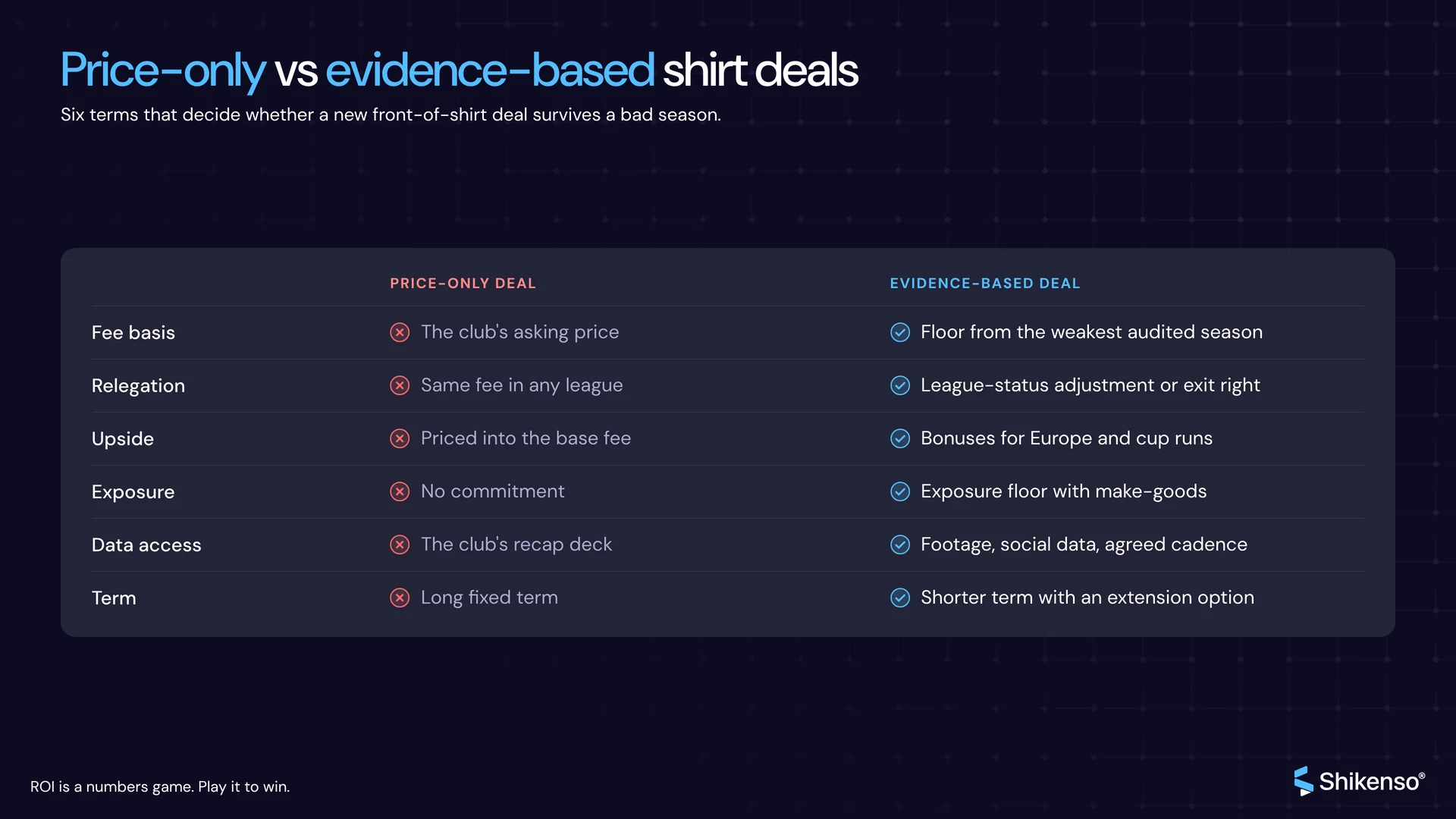
Five clauses are worth asking for in any new front-of-shirt sponsorship:
- League-status adjustment. A lower fee, or an exit right, if the club is relegated. With Gladbach still bottom of the table in November, this is not a theoretical risk.
- Performance bonuses. Extra payments for European qualification or cup runs, funded by the extra exposure those bring.
- Exposure floor. A minimum level of quality-weighted exposure per season, with make-goods such as extra assets or content if the slot falls short.
- Data access. Match footage, social data and reporting at an agreed frequency, so both sides measure the same thing.
- Term and options. A shorter fixed term with an option to extend, rather than a long contract priced during a crisis. Football Benchmark found that big five shirt deals average slightly under three years, while small and mid-sized clubs often sign for one or two years.
Our position: a sponsor that negotiates on the asking price alone is paying for the club's hopes, not for the slot's history. We expect exposure floors and make-goods, long standard in media buying, to become routine in mid-table Bundesliga shirt deals by 2028.
The same playbook for any Bundesliga shirt slot
The method is not specific to Gladbach. Any Bundesliga shirt sponsorship that changes hands in 2027 comes with an incumbent's history, and that history is the best data a new sponsor will ever get about the slot.
Club commercial teams can use the same audit from the other side. A pitch that shows what the shirt delivered, independently measured and split by channel, is harder to discount than a rate card. Our analysis of how football advertising boards are priced applies the same logic to perimeter boards.
For German brands, the window is now. Shirt deals for 2027/28 will be negotiated over the winter, and an audit of three seasons takes weeks, not days.
The Bottom Line
Gladbach's search for a new shirt sponsor is a rare chance: a slot with three seasons of measurable history, a club under sporting pressure, and most of a year to prepare.
The brand that comes to the table with an independent record of what the slot delivered will set the terms. The brand that comes with only a budget will accept the club's. Before you sign, find out what the slot really delivered: Shikenso for brands runs the audit across every channel the shirt appears in.

Related reads


Get new insights straight to your inbox
Don’t miss out on the insights that the press and media rave about!