

Picture a budget review in November. The sponsorship team puts up a slide: a €2 million sleeve deal delivered €14 million in media value. A seven-to-one return. The CFO asks one question: "Would we ever have paid €14 million to buy that exposure?"
Nobody says yes. From that moment, every other number in the deck is discounted too.
Versions of this meeting are happening across German marketing departments right now, as 2027 budgets get locked. The critics of sponsorship media value are mostly right about the symptoms. They are wrong about the cure.
Why media value lost the room
Sponsorship media value is the price a brand would have paid to buy the same exposure as advertising. It became the default sponsorship metric because it turns logos, mentions and clips into one euro figure. It lost credibility because that figure was too often built on assumptions nobody could check.
The backlash didn't come from nowhere. Sponsorship now competes for budget with channels that report results daily, down to the euro.
According to Lumency's 2026 Global Sponsorship Trends report, around three-quarters of brand owners name ROI measurement as their biggest sponsorship challenge, ahead of rights access or activation complexity.
The way deals are bought has changed too. Procurement teams now review sponsorship contracts the way they review software licences, and investor-backed rights holders are writing performance triggers into contracts. In that environment, a number that looks inflated doesn't just fail to persuade. It damages the credibility of whoever presents it.
So when agencies say "stop reporting media value", they're reacting to a real problem. But look at what usually replaces it: a brand lift survey, a sentiment score, a modelled ROI figure. None of them can tell you what you actually received for your money.
What does lazy media value look like?
Lazy media value is easy to spot once you know the patterns. Five habits do most of the damage: counting every second of exposure the same, using the wrong price list, applying a PR multiplier, letting the rights holder grade its own homework, and reporting one number once a year. Many recap decks contain three or more of them.
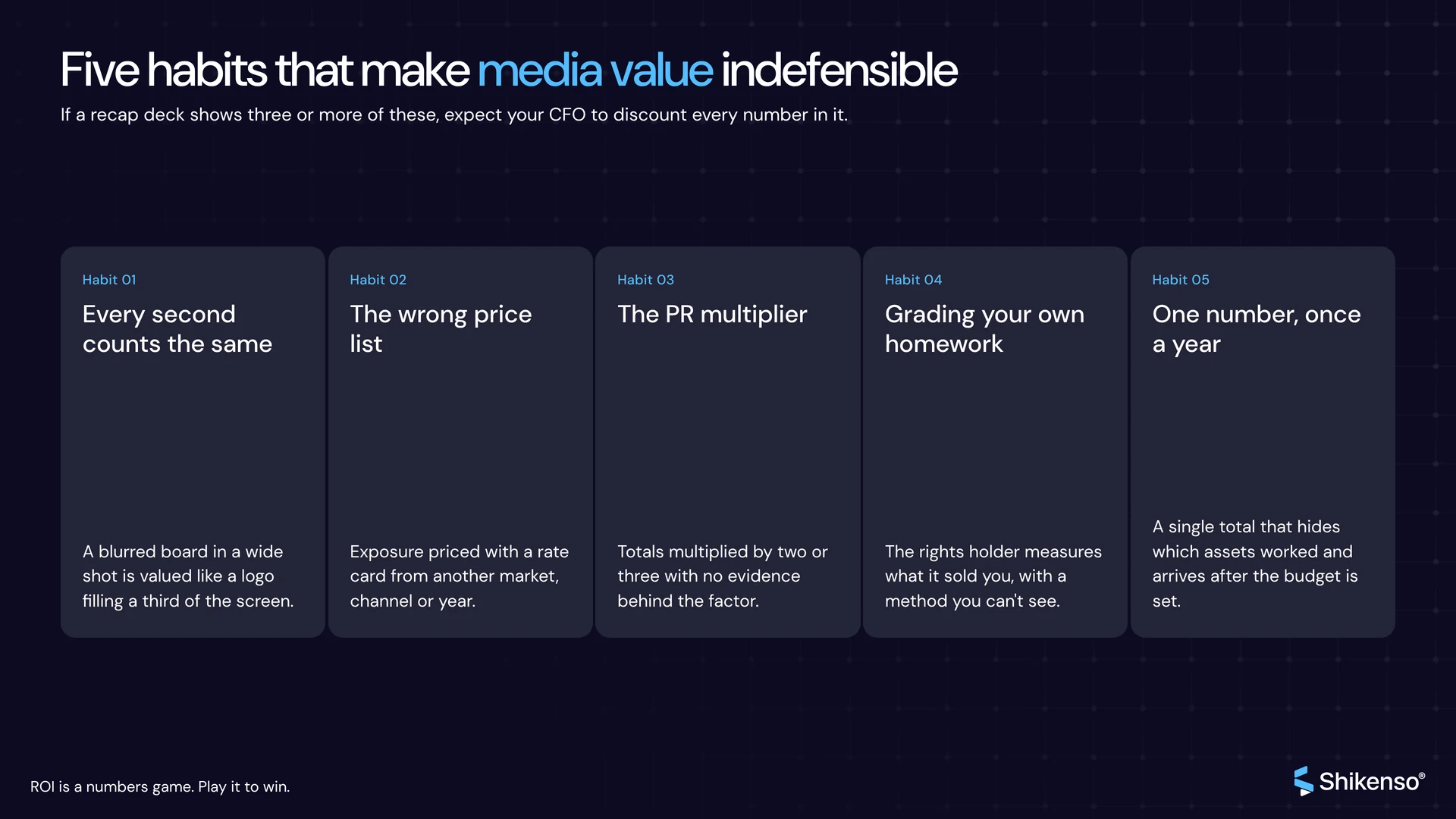
The most common is pricing. A stream view in Germany is not worth a US prime-time TV impression, and a Twitch impression is not a linear TV spot. The second most common is the PR multiplier: totals multiplied by two or three because "editorial exposure is worth more". There is no evidence that editorial exposure is worth a fixed factor more, so the multiplier only inflates the total.
Should brands stop reporting media value?
No. Here is the unpopular part: if you drop exposure measurement and rely on outcome metrics alone, you lose the only link in the chain you can verify directly.
Take brand lift surveys. A Toluna and DHBW Mannheim study published in July 2026 asked consumers in Germany about World Cup sponsorship. Over half said official sponsor status had no effect on their purchase decisions, and around 34% linked Nike to the official sponsors, although Nike wasn't one. Recall data alone can't separate what a sponsor earned from what a famous brand absorbs anyway.
Take modelled ROI. Brand Finance estimated that World Cup 2026 sponsors turned US$2.8 billion into about US$61 billion of enterprise value. It's a striking number, and by Brand Finance's own description a modelled estimate. It also hides a wide spread: 12 of the 21 sponsors analysed recorded below-average uplift.
Every outcome method needs an exposure input it can trust. Brand lift needs to know who was exposed. Sales attribution needs to know when and where exposure peaked. Test-and-control designs need a clean record of which markets saw which assets. Remove the exposure layer and the rest of the stack has nothing to stand on.
What does defensible sponsorship media value look like?
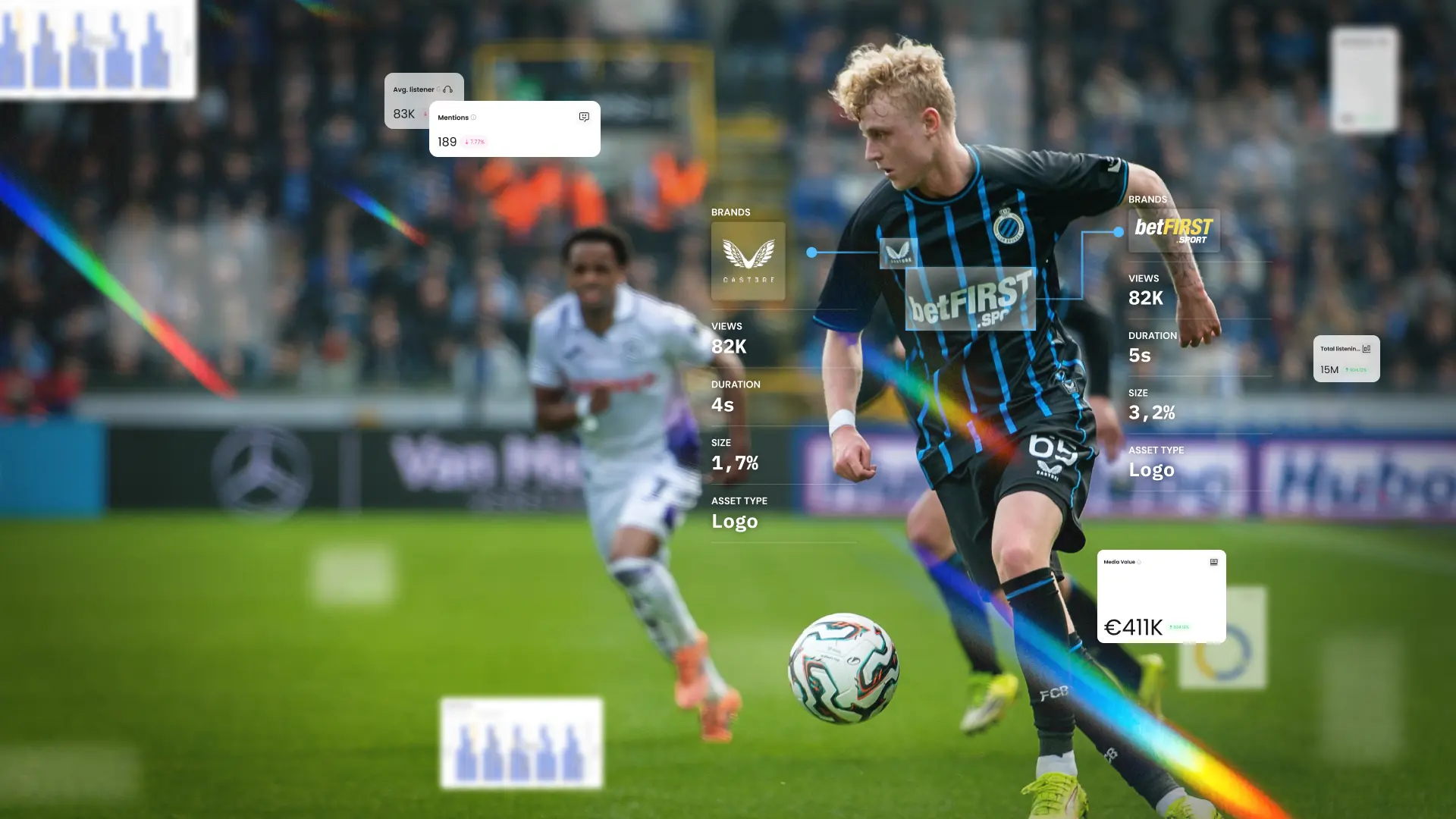
Defensible media value is a figure you could hand to your finance director, your procurement team or an auditor, and explain line by line. It weights every detection for size, position, clarity and duration, prices each impression by market and channel, and counts what people hear and read, not just what they see. If you want the mechanics, our guide to how media value is calculated walks through the formula.
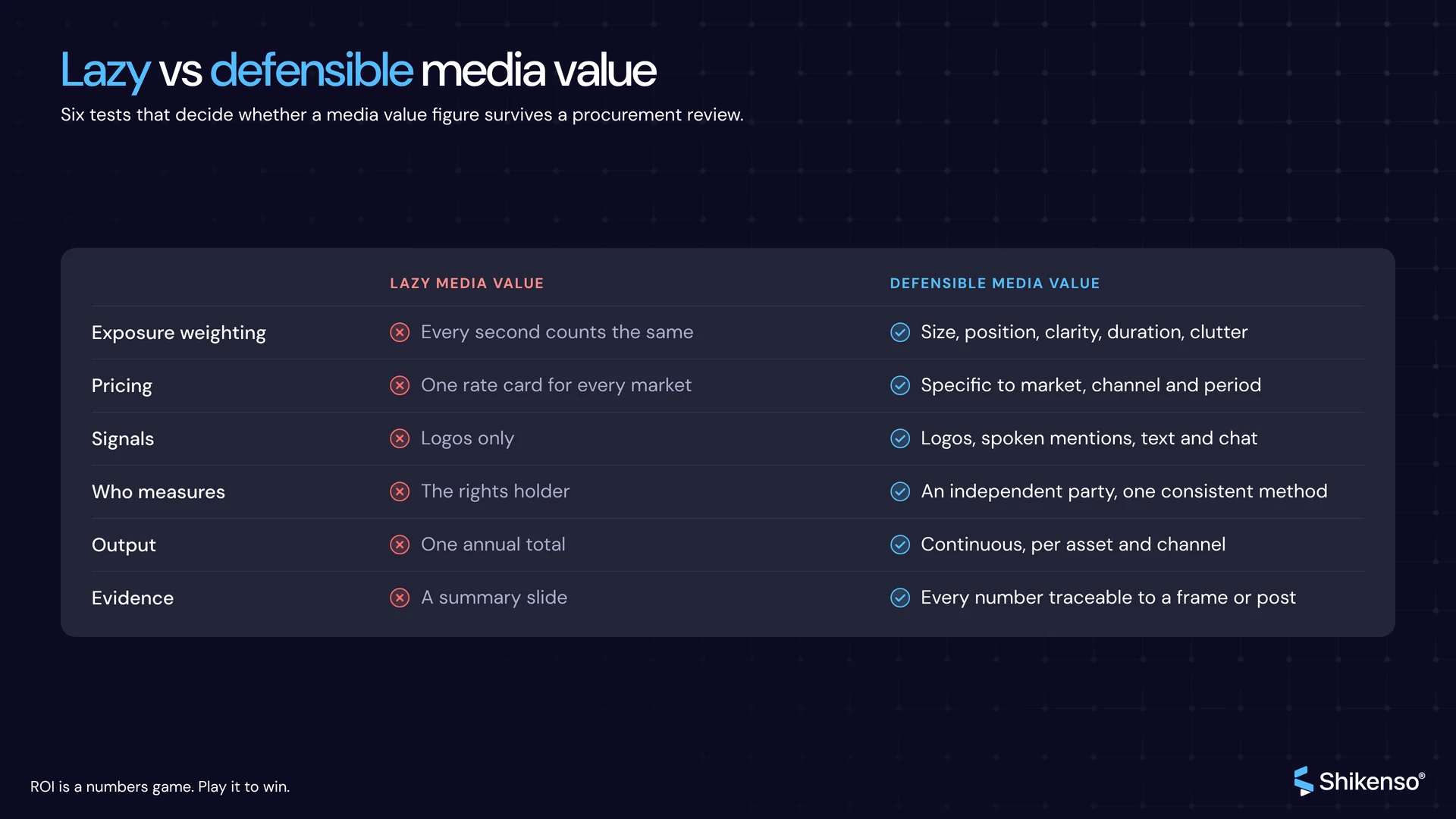
Two of these tests matter most in renewals. Independent measurement removes the conflict of interest in a rights holder grading its own homework. And traceability, where every number links back to a frame, post or clip, ends the argument about where a figure came from. That is also why logo detection has to score prominence, not just presence.
Media value is the floor, not the ceiling
Even defensible media value doesn't answer every question. It tells you what you received and what that exposure would cost to buy elsewhere. It doesn't tell you whether people changed their opinion or their shopping basket.
That's why it belongs at the bottom of a measurement stack, not at the top of the slide. Bain recommends judging sponsorship on brand impact, engagement and commercial outcomes. We'd put exposure underneath as the foundation.
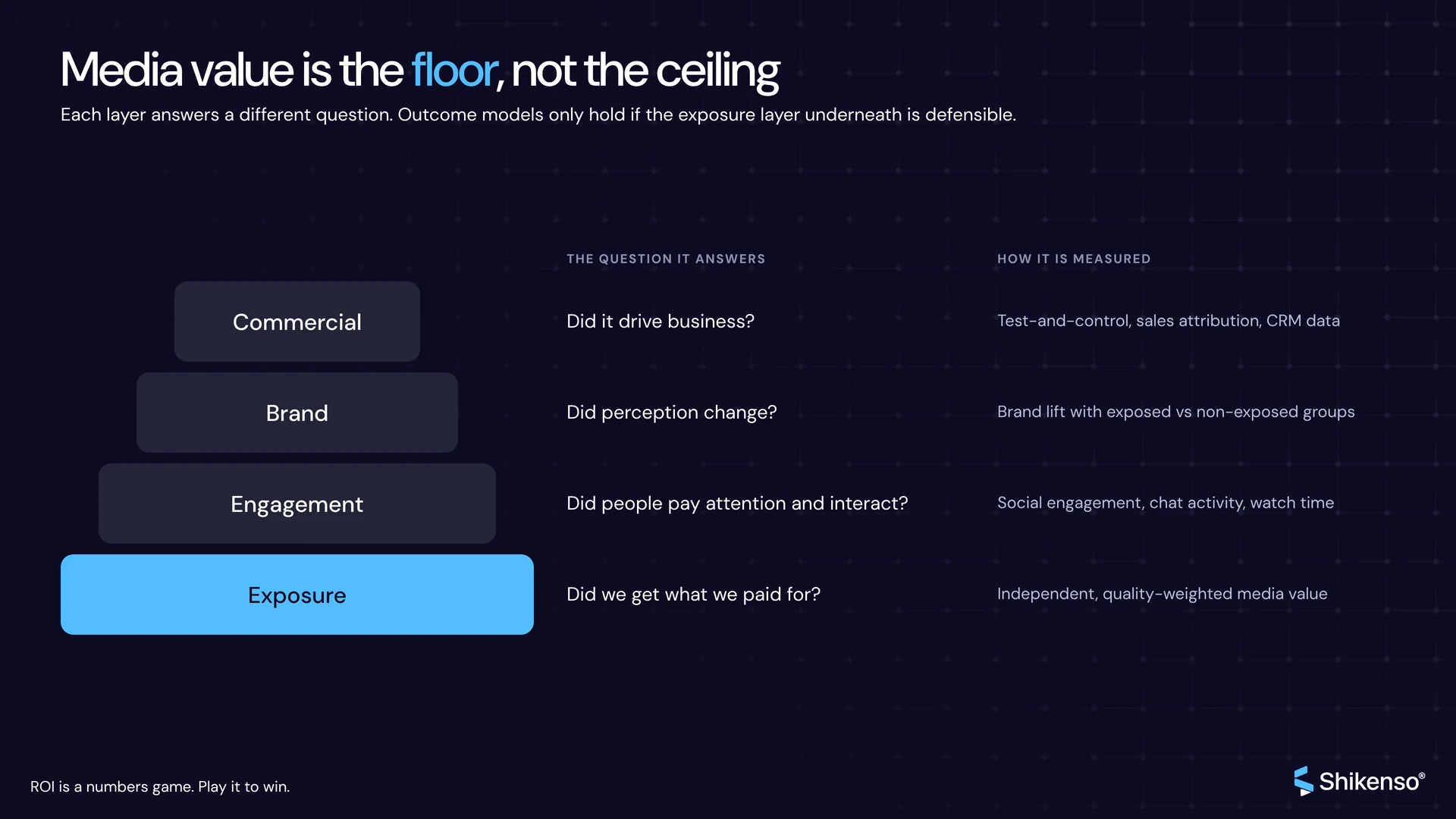
Two mistakes are common. The first is jumping straight to the commercial layer on a weak foundation. The second is presenting the exposure layer as if it were ROI. "€14 million in media value" invites the CFO's question. "We received exposure worth €14 million at market prices, 18% above contract, at a lower cost per quality-weighted impression than our TV buys" starts a better conversation. Our sponsorship ROI framework shows how the layers connect.
What German brands should do before 2027 renewals
- Ask every rights holder for their methodology. If they can't explain how exposure is weighted and priced, treat the recap as marketing material, not data.
- Fund measurement properly. Lumency estimates brands spend under 1% of sponsorship investment on measurement, against around 3% in other channels.
- Compare deals on cost per quality-weighted exposure. Put football, esports, events and creator partnerships on one scale.
- Stop reporting one number. Report exposure, engagement, brand and commercial results separately.
- Write measurement into the contract. Agree KPIs, data access and reporting cadence before you sign. Our guide to choosing a measurement platform lists the questions to ask.
Four predictions for 2028
- Self-reported recaps lose their seat at the table. Procurement will require independent measurement above a certain deal size.
- Media value becomes a contract currency. Exposure guarantees and make-goods move from media buying into sponsorship contracts.
- Multipliers disappear. Any figure that can't be traced to evidence drops out of board-level reporting.
- Reports become queries. Brand managers will ask their sponsorship data direct questions instead of waiting weeks for a recap deck.
The Bottom Line
The critics of media value are right that the industry's old habits produced numbers nobody believed. But the answer to bad measurement is better measurement, not less of it. Brands that build their sponsorship case on defensible exposure data will walk into 2027 renewals with a number their CFO doesn't argue with.

Related reads



Get new insights straight to your inbox
Don’t miss out on the insights that the press and media rave about!