

The 2027 budget meeting will start with AI. That's where the money grew fastest, and that's where finance will look first. Forrester expects marketers to scale back a third of their AI initiatives next year, with procurement and finance taking a bigger seat at the table.
But a finance team that has just learned to audit AI spend line by line won't stop there. The next lines on the sheet are the big, fixed, multi-year ones. For many German brands, that means sponsorship.
The Forrester predictions 2027 are about AI. The proof bar they describe applies to everything.
What do the Forrester predictions 2027 say?
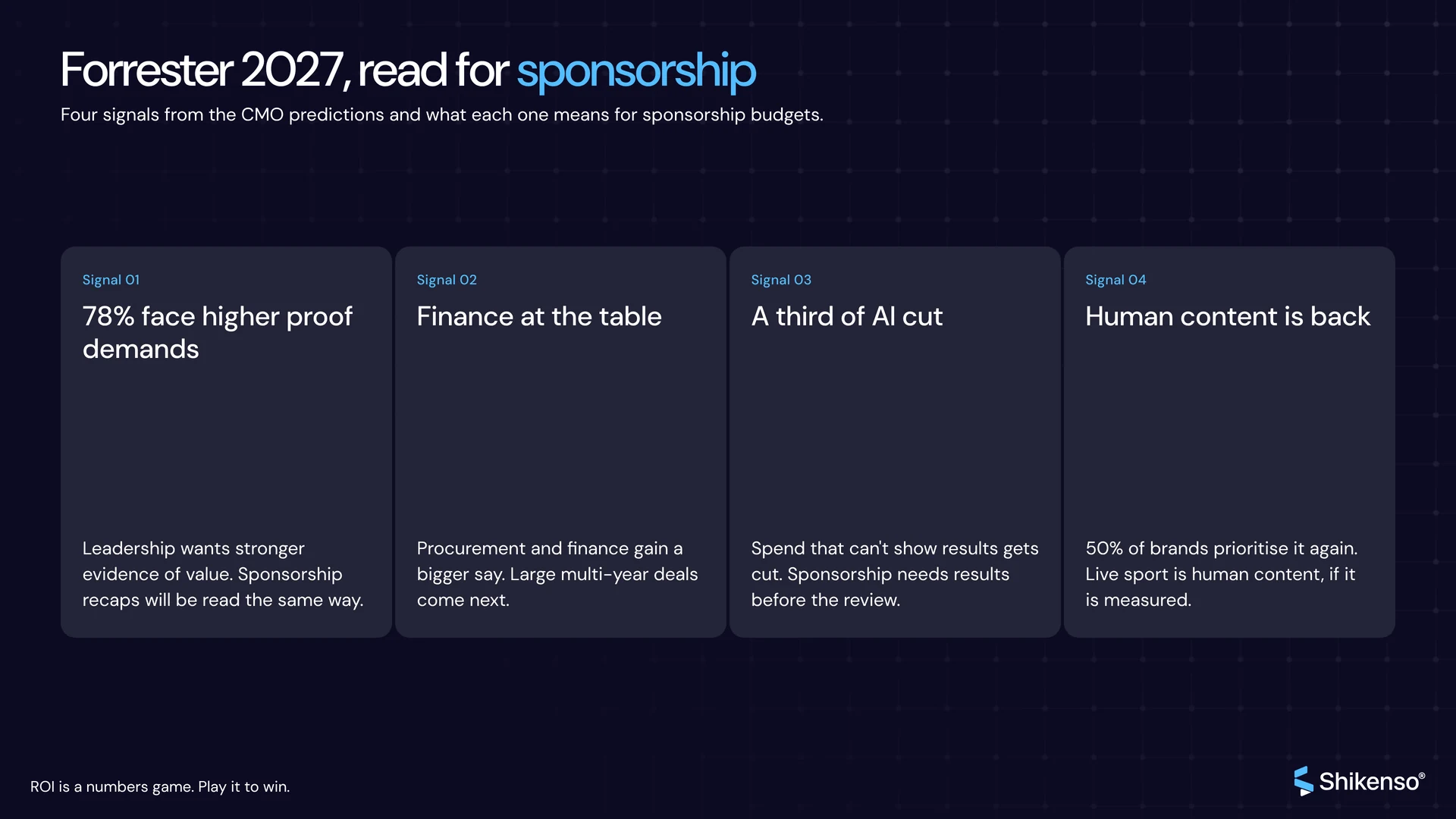
Forrester predictions 2027 refers to the research firm's annual forecasts for the year ahead. For CMOs, they describe an AI reality check: marketing will keep using AI, but every initiative has to earn its budget. In its predictions blog published on 21 October 2026, Forrester forecasts three shifts for marketing leaders.
- A third of AI initiatives will be scaled back. Usage-based pricing turns every prompt, agent interaction and generated asset into a cost, and costs that are hard to forecast get cut.
- Procurement and finance will play a larger role in AI decisions, because consumption costs are harder to predict than licence fees.
- AI agents will replace legacy marketing and insights tools at one in 10 companies.
The data behind it comes from Forrester's Q3 2026 CMO Pulse Survey of US B2C marketing executives. 82% expect to give stronger justification for future AI investments, and 78% say executive leadership demands stronger evidence of value than it did 12 months ago.
Two numbers from the wider B2C predictions release matter for sponsorship as well. Forrester expects human-generated content to become a top priority again for 50% of brands, and customer experience staffing to rise by 20% after cuts went too far.
Why sponsorship ROI proof is next after AI
The proof bar won't stop at AI because the habit it builds is general: once finance has a method to question one budget line, it applies that method to every line. AI is simply the first test case, because its costs moved fastest.
Forrester's own framing points that way. The authors write that CMOs will put AI through the same scrutiny as every other marketing investment. Read the other way round, every other investment gets the scrutiny AI is about to get.
Sponsorship is exposed for three reasons:
- Size. A shirt, naming or league partnership is often the largest single line in a brand's marketing plan.
- Duration. Multi-year contracts lock in money long before results are known, which is exactly what makes a CFO nervous.
- Reporting habits. Many sponsorship recaps still lead with one media value total, delivered once a year by the rights holder. That format doesn't survive a line-by-line review.
A caution for readers outside the US: Forrester's survey covers US consumer brands, and its predictions are forecasts, not findings. As the Inc. column on the report points out, the figures are drawn from consumer brands. The direction still transfers. Finance teams in Europe and other markets are no less exacting, and in our experience procurement already reviews many large sponsorship contracts.
How will finance read a sponsorship report in 2027?
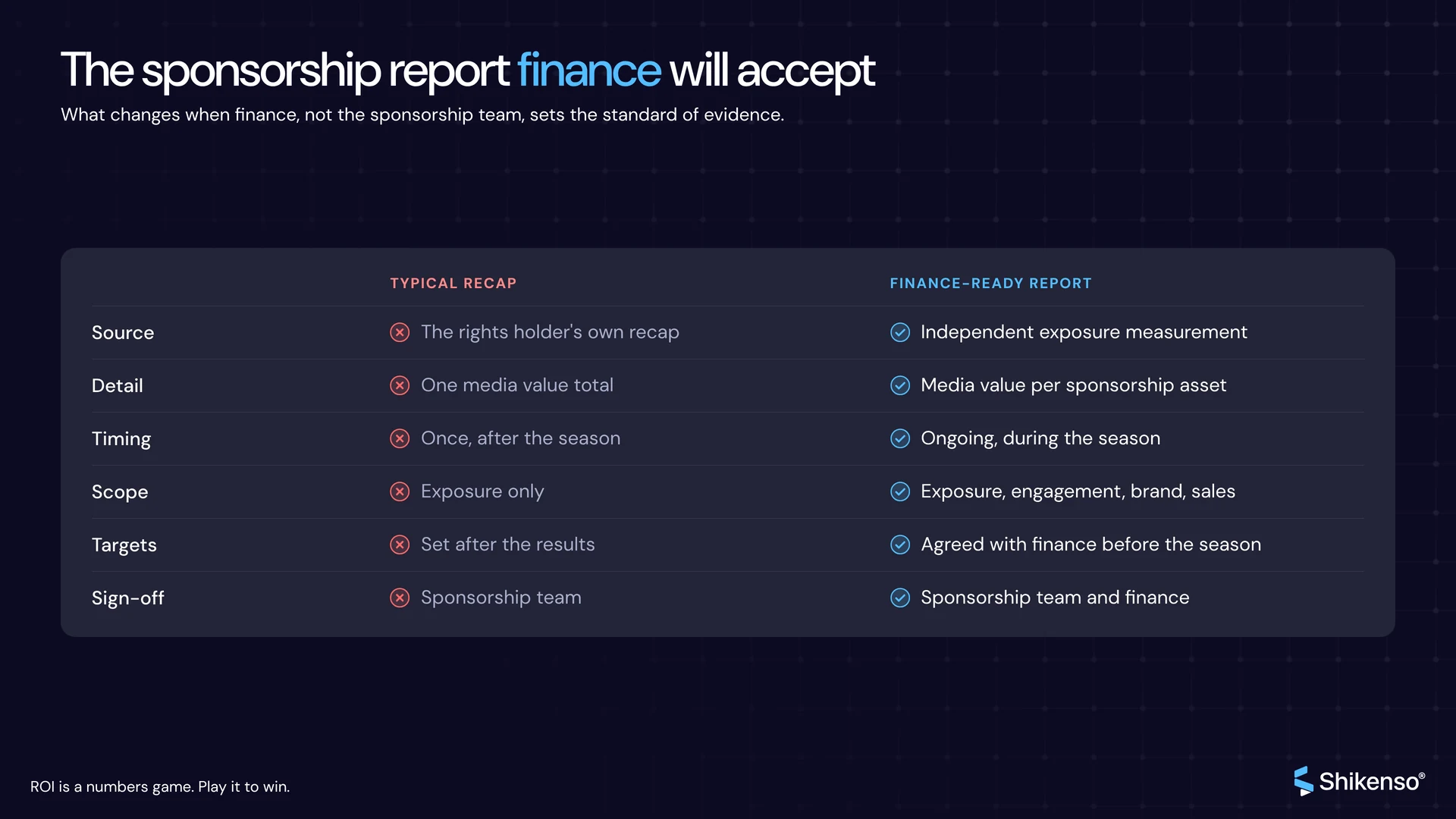
Finance will read a sponsorship report in 2027 the way it reads any other investment case: what did we buy, what did each part of it deliver, how does that compare with what we paid, and when did we know. A report that answers those questions asset by asset, while the season is still running, gets through. One that leads with a single headline total after the season doesn't.
The shift is less about new metrics and more about who sets the standard. Until now, the sponsorship team decided what success looked like. In 2027, finance will increasingly decide what counts as evidence.
The gap shows in AI too. The same Inc. column cites a separate Basis survey of 184 marketing and advertising professionals: only 6.5% measure the return on their AI use against defined benchmarks, and 65% don't measure it or don't know whether anyone does. Sponsorship teams that can show benchmarked results will stand out against that background.
Why human content works in sponsorship's favour
Forrester's forecast that human-generated content becomes a top priority again for half of brands is good news for sponsorship. Live sport, athletes and fans are the most human content there is, and AI can't fake a last-minute equaliser.
That advantage only counts if it can be shown. "People love football" isn't evidence. Evidence is the exposure a partnership delivered across broadcast, streams, social and creator content, broken down by sponsorship asset, and how audiences responded.
That is the case sponsorship can make in 2027: real people, real moments, and numbers that prove both.
What brands should do before the 2027 budget round
Brands should prepare sponsorship for a finance-led review before the budget round starts, not during it. Five steps cover most of what finance will ask for.
- Agree the outcomes with finance first. Set exposure, engagement, brand and commercial targets per partnership, in numbers, before the season. Our guide to which sponsorship KPIs to track lists the options.
- Use independent exposure data. A rights holder's own recap is a sales document. Finance will discount it, so measure exposure yourself or through an independent third party.
- Break media value down by asset. One total hides what works. Media value per asset, such as the shirt, the LED boards, social posts and athlete content, shows which parts of a deal earn their fee.
- Show the layers separately. Exposure, engagement, brand and sales answer different questions, and a brand measurement strategy assigns a method to each. Our sponsorship ROI framework shows how they connect.
- Report during the season, not after it. Results that arrive while the season is running give finance time to ask questions and leave time to change the activation.
Shikenso measures exposure across TV, streams, social and online media independently of the rights holder, with media value broken down by sponsorship asset and results available during the season. That covers steps two, three and five before the budget meeting starts.
Our view: three predictions for sponsorship in 2027
Forrester's predictions are about AI. Here is what we expect the same pressure to do to sponsorship.
- Finance joins renewal meetings. For deals above a certain size, the CFO's team will sit in on the renewal decision, not just sign the invoice.
- Media value gets itemised. "We received €14 million in media value" gives way to a breakdown by asset: what the shirt, the LED boards and the athlete content each delivered.
- Self-reported recaps lose weight. A recap produced by the party that sold the deal will count as context, not as evidence.
The Bottom Line
The Forrester predictions 2027 are a warning about AI budgets, but the lesson is wider. Finance is building a habit of asking for proof, and sponsorship is one of the largest lines it will look at next. Brands that bring independent numbers, asset by asset, to that meeting will keep their best partnerships. The best time to build that case is now: test your deals against the 2027 bar.

Related reads






Get new insights straight to your inbox
Don’t miss out on the insights that the press and media rave about!