

It's March, and the board wants to know what the football sponsorship delivered. The sponsorship team has an agency recap with a media value total. Market research has a brand tracker. The social team has engagement numbers. Sales has no idea.
Every one of those numbers is real. None of them answers the question, because nobody connected them. The problem isn't missing data. It's a missing sponsorship measurement framework: a structure that says which number answers which question.
The fix is to stack the evidence, so each layer answers one question and feeds the next.
What is a sponsorship measurement framework?
A sponsorship measurement framework is the set of questions, metrics, methods and owners a brand uses to judge a sponsorship, ordered so each answer feeds the next. The ROI stack is our version of it: four layers, with exposure at the bottom and commercial outcomes at the top.
The layers follow the logic of how a sponsorship works. People have to see the brand before they can engage with it. They have to engage before perception moves. And perception has to move before it shows up in sales.
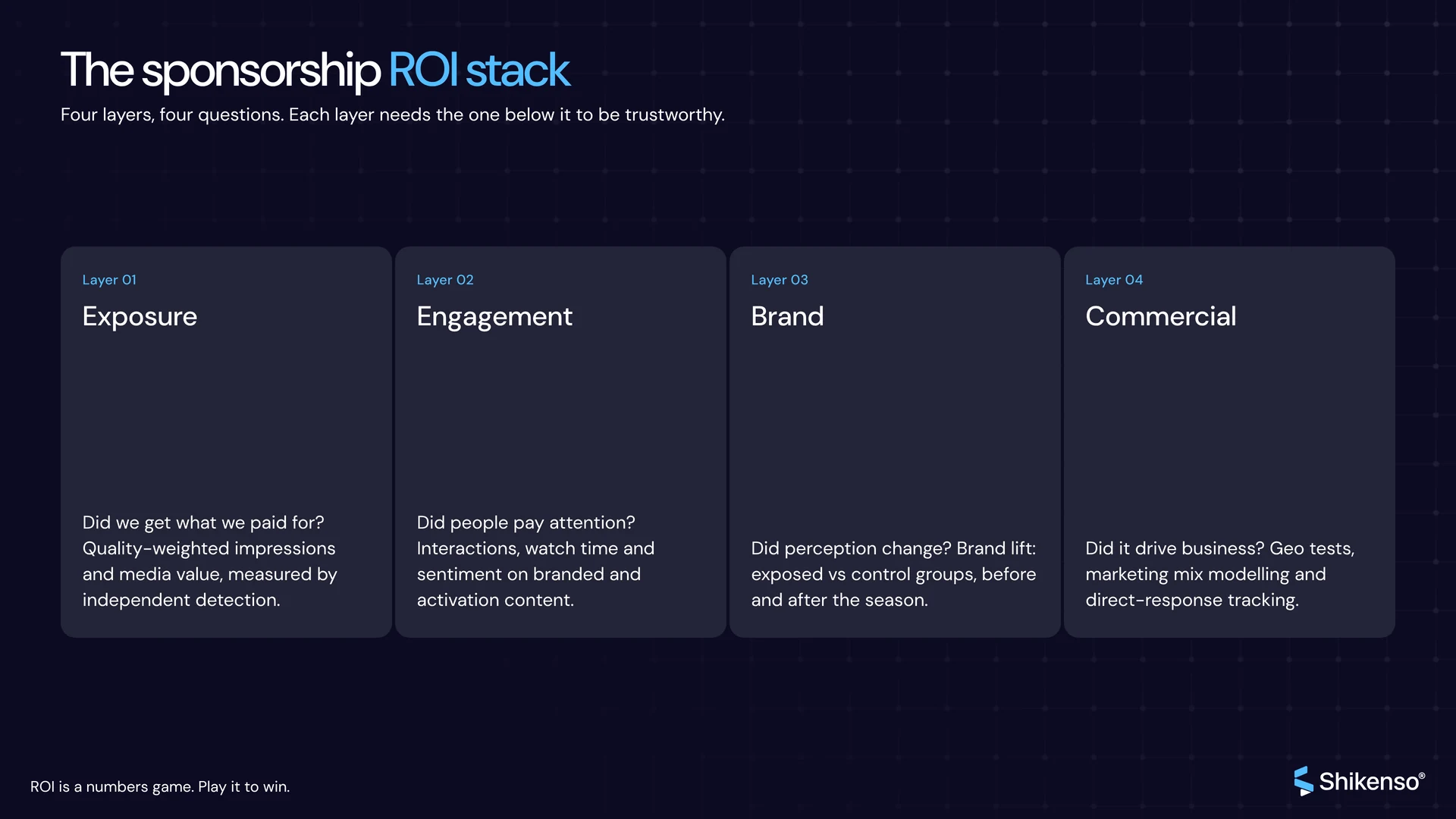
Bain's 2026 analysis of sports sponsorship recommends judging sponsorship on brand impact, engagement and commercial outcomes. The ROI stack adds exposure underneath as the foundation, because every method above it needs to know who was exposed, where and when.
Why do German brands need a measurement framework now?
German brands need a sponsorship measurement framework because the money is large, the scrutiny is rising and German audiences are harder to win over than the global average. A recap deck full of exposure totals no longer survives a budget review.
The scale is significant. Clubs in the Bundesliga and 2. Bundesliga earned €1.15bn from sponsorship and advertising in 2024-25, according to the DFL's economic report. Yet according to Lumency's 2026 Global Sponsorship Trends report, around three-quarters of brand owners name ROI measurement as their biggest sponsorship challenge.
German fans also don't reward sponsors automatically. YouGov's 2026 World Cup research found that 45% of German World Cup followers consciously notice brands around the tournament, against 56% across 19 markets.
The same research shows a sharp age gap: 72% of younger German followers notice sponsors, against 36% of older ones. Exposure alone tells you nothing about which of those audiences moved. Only a layered framework does.
Layer 1, exposure: did we get what we paid for?
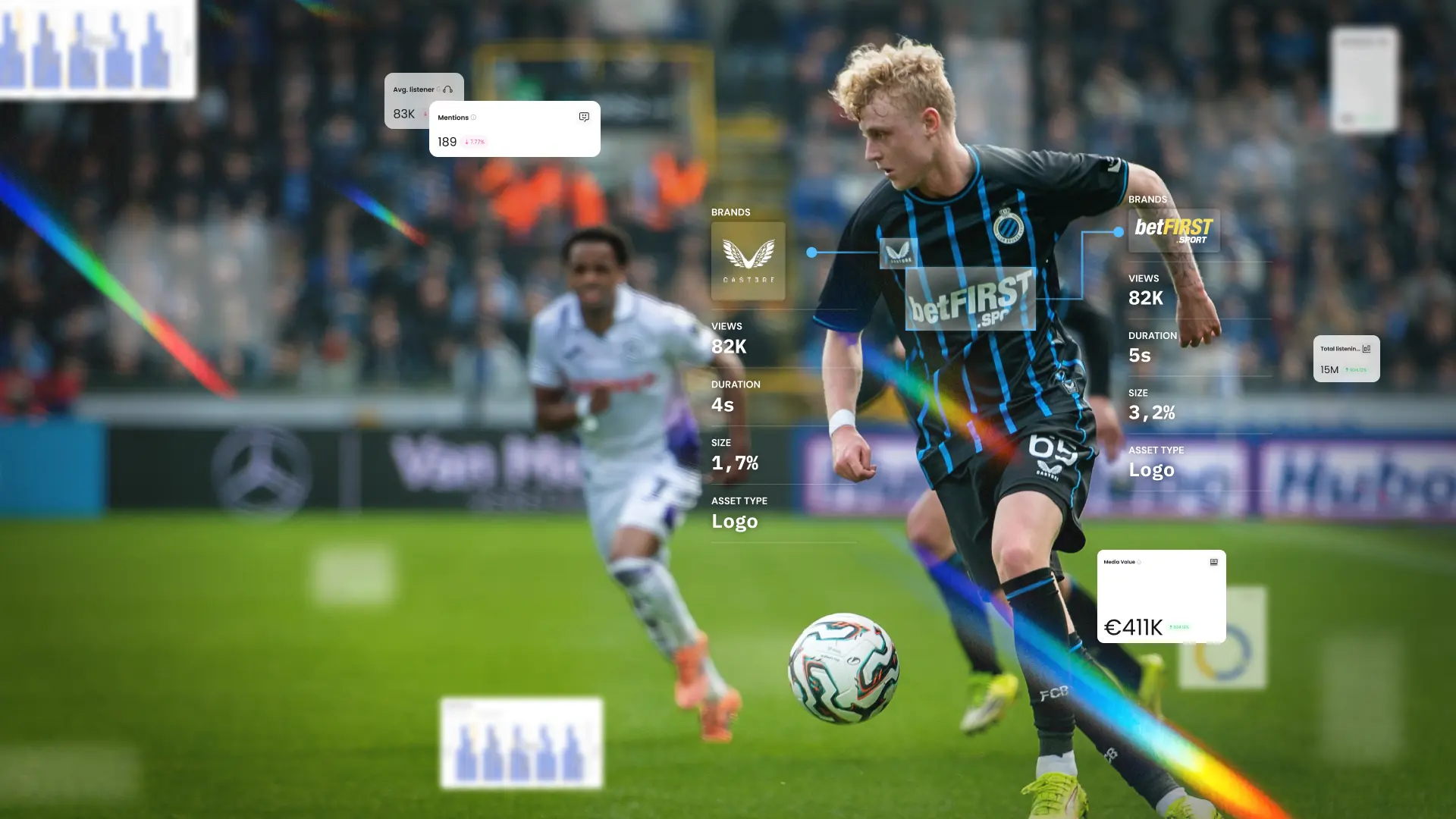
The exposure layer answers whether the sponsorship delivered the visibility the contract promised, at a price that compares with other media. Exposure is the foundation of the ROI stack, so it has to be measured independently, continuously and at asset level.
Measure four things here:
- Quality-weighted impressions per asset, channel and market, weighted for size, position, clarity and duration.
- Media value priced by market and channel. Our guide to how media value is calculated walks through the formula.
- Delivery against contract: every asset the contract promises, checked against what actually ran.
- Cost per quality-weighted impression, so a jersey deal, a perimeter package and a creator partnership can be compared on one scale.
The method is automated detection across TV, streams, social and online media, covering logos as well as spoken and written mentions. That's why logo detection has to score prominence, not just presence. Owner: the sponsorship team. Cadence: continuous, reviewed monthly.
Layer 2, engagement: did people pay attention?
The engagement layer answers whether the audience interacted with the sponsorship, not just whether the logo was on screen. Engagement separates exposure people scrolled past from exposure that held attention.
A June 2026 study by Omnicom Media Group Switzerland around the Ice Hockey World Championship found only a weak link between the amount of advertising exposure and image transfer to the brand. The quality of the message mattered more than volume.
Typical engagement metrics are interactions and watch time on branded and activation content, sentiment in comments and chat, and traffic or sign-ups from activations. Track them per activation, so you learn which content worked. Owner: the social and activation team. Cadence: per activation, summarised monthly.
Layer 3, brand: did perception change?
The brand layer answers whether the sponsorship changed what people think about the brand. The standard method is a brand lift study that compares exposed and unexposed audiences, or the same audience before and after, against a control group.
Brand lift depends on the exposure layer. The exposure data tells you which markets, channels and audiences saw the sponsorship, so the research team can sample exposed and control groups properly instead of guessing.
Measure sponsor awareness, correct sponsor attribution, consideration and the image attributes the deal is meant to build. Correct attribution matters more than recall. In a Toluna and DHBW Mannheim study published in July 2026, around 34% of respondents in Germany linked Nike to the official World Cup sponsors, although Nike wasn't one.
Owner: market research or the brand team. Cadence: a baseline before the season, a mid-season wave and a post-season wave.
Layer 4, commercial: did it drive business?
The commercial layer answers whether the sponsorship drove sales, leads or customer value. Commercial proof is the top of the ROI stack and the hardest layer, because sales have many causes. Three methods work, ideally in combination.
- Geo tests. Activate in some regions and not in others, then compare sales. Google made its open-source Meridian GeoX experiments generally available in September 2026, which lowers the cost of running one.
- Marketing mix modelling. Add sponsorship to the model as weekly quality-weighted exposure from layer 1, not as one annual fee. Spend is flat across a season, so the model can't see what happened. Exposure varies week by week, so it can.
- Direct response. Promo codes, dedicated landing pages and CRM tags for hospitality and B2B leads catch the part of the effect that is directly traceable.
Owner: performance marketing or analytics, with finance signing off. Cadence: quarterly, with a full read before the renewal decision. Our sponsorship ROI framework shows how to turn these results into one ROI figure.
How to build the sponsorship ROI stack in one season
A sponsorship ROI stack can be built in one season if the baseline is in place before the first match. Most measurement fails because the brand starts measuring after the money is spent, when there is nothing to compare against.
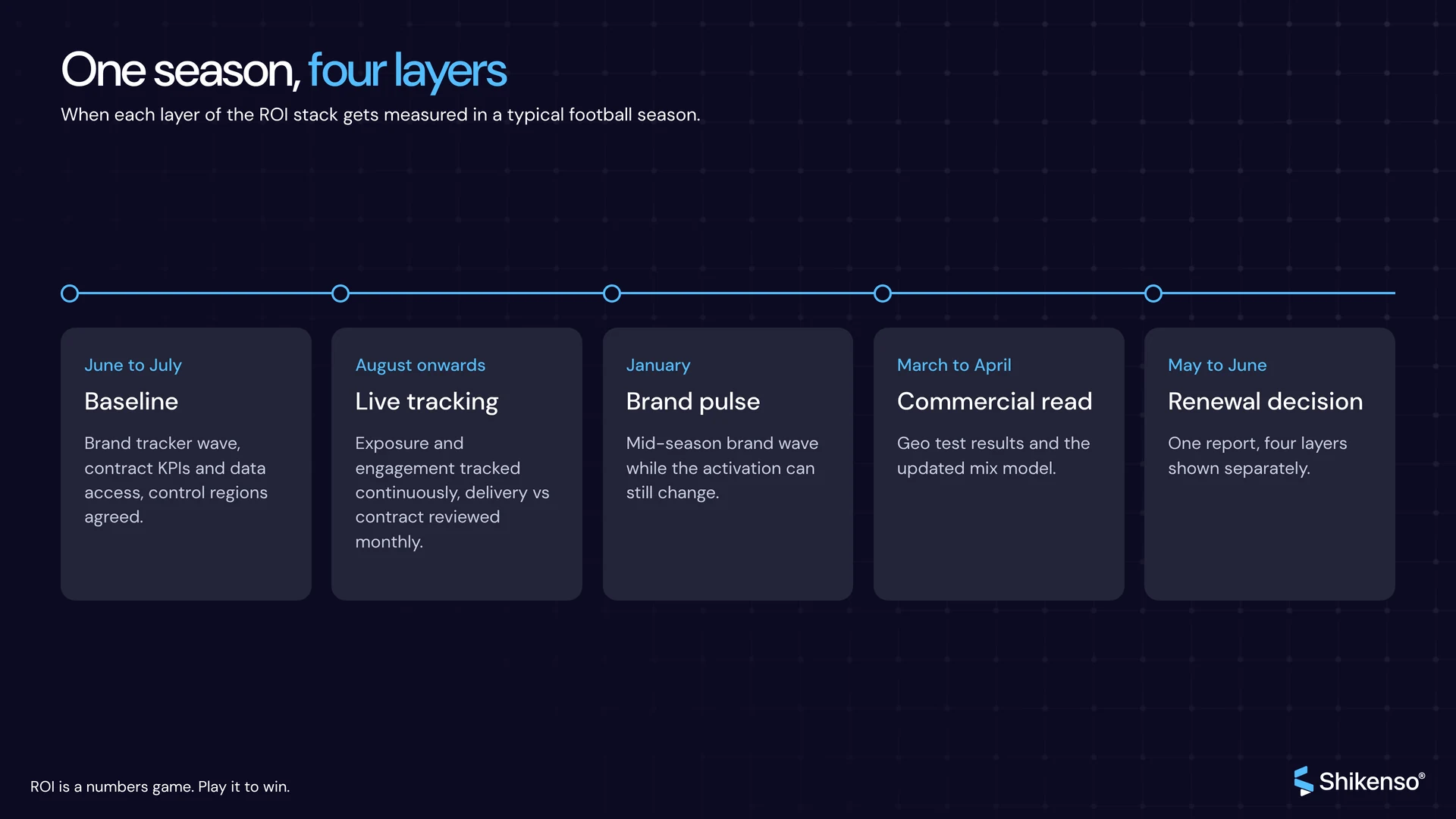
- Before the season: set the baseline. Run a brand tracker wave, write exposure KPIs and data access into the contract, and agree which regions or audiences act as control groups.
- During the season: measure exposure and engagement continuously. Review delivery against contract monthly and move activation budget to the assets that perform.
- Mid-season: run a brand pulse. A second brand wave shows early movement while there is still time to change the activation.
- End of season: read the commercial layer. Geo test results and the updated marketing mix model go into one renewal report, with each layer shown separately.
Lumency estimates brands spend under 1% of sponsorship investment on measurement, against around 3% in other marketing channels. Closing part of that gap pays for the layers most brands skip.
Platforms such as Shikenso cover the exposure and engagement layers and export weekly exposure data in the shape a mix model or geo test needs.
Three mistakes that break the stack
The three most common mistakes in sponsorship measurement are skipping the baseline, measuring the top layer on a weak foundation and blending all four layers into one ROI number.
- No baseline. Without a pre-season brand wave and contract KPIs, there is nothing to measure change against.
- Building on sand. A brand lift study or mix model fed with unweighted, self-reported exposure inherits every error in it.
- One blended number. A single "ROI 4.2x" figure hides which layer worked. Report the four layers separately, then the combined view. Our guide to which sponsorship KPIs to track lists the metrics per layer.
The Bottom Line
Sponsorship ROI isn't one number that someone has to find. Sponsorship ROI is four answers that have to connect. Brands that build the ROI stack before the season walk into their 2027 renewals with evidence for every layer, and with a clear view of which assets to keep.

Related reads


Get new insights straight to your inbox
Don’t miss out on the insights that the press and media rave about!